Like many women in downtown Chicago, I seek gynecological care in a building that houses the Playboy offices. The sight of so many pregnant women tottering back and forth beneath the shiny chrome PLAYBOY sign in the lobby always cracks me up. There is a pretty constant stream of women, usually slender women (this is a swanky part of the city) with pregnancy-related deviations from the thin woman profile--a belt tied higher than normal over a swelling belly--on their way to the banks of elevators under its benediction. It's a busy place.
I walked into a doctor's waiting room in that building recently and suddenly remembered--oh, right. This room. I am not in that waiting room very often anymore, and I had forgotten that it was one where I had lobbied for years for more accommodating seating.
The room has maybe 30 unusually narrow wooden chairs, with arms, placed closely together, the same ones there have always been. But there is also now a love seat, upholstered in some mid-90s hotel pattern, the result (I was told) of all the comment cards I filled out, over and over, full of underlinings and exclamation points, pointing out the lack of seating for people of size.
At the point in my life in which I was in that waiting room a lot I had back problems and terrible mobility. Standing was even harder than walking, and it was horrible to know that after I had struggled painfully down the hall to the office there would be more urgent distress instead of relief. None of the narrow chairs fit me. It was a frantic feeling to be in so much pain while people around me were nominally relaxed. It was humiliating. I often felt like I wouldn't make it.
I am a resourceful, wide-hipped fatty, willing to advocate for myself with regard to seating as necessary, without too much apology or defensive anger most (not all) of the time, but the message implicit in that room--unintended, but very clear--got me down sometimes. Sometimes it got me down a lot. I was not welcome. I know my doctor didn't mean to say that to me, but she did. Her waiting room did.
I would "stand" by the receptionist, sweating with pain, holding myself up by leaning gracelessly against the wall, hard, making (I'm sure) weird facial expressions to deal with the effort, feeling conspicuous and angry and embarrassed. I was in an office attending to the demands of the human body, but when you got down to it, there was nowhere for mine in it. Without being in a wheelchair, which was a line I guess I wasn't willing to cross, I had no way to make do. They had even gotten rid of the stool-like end tables that I would sometimes commandeer for myself, startled patients watching me sweep the brochures off them as I plopped down as discreetly as I could.
So I grit my teeth and sweated, and I wrote and I wrote my frustrations on comment cards and told the nurses and the doctors about the problem every time I was there. I was really mad about the big issue here. I mentioned all the other people besides me who could use better seating, talking about the demands of pregnant women and the elderly and feeling frustrated that in my ears that sometimes sounded more convincing than my own needs. Eventually the fugly love seat arrived. Eventually I regained my mobility too, after a lot of rehab and work. Eventually I wasn't in that doctor's office as much.
When I entered the waiting room this time there was a couple sitting on the love seat, their limbs tangled casually together, texting on their cellphones and looking very comfortable. They were the opposite of the image of a nervous couple waiting for the doctor. There was nobody else in the waiting room, just rows of empty chairs.
After checking in and hanging up my coat I went to stand in a somewhat out of the way spot in the waiting room. The one seat that could fit me was filled, and well-used, I thought, by this couple able to relax together on the seat a little and feel comfortable before a doctor's visit, and not by somebody who, for instance, just wanted a cushy seat for her purse, whom I might ask to give me her space. So that was that. The seat was theirs. I would be standing for the duration.
Social behaviors in a doctor's waiting room are very narrowly defined. You are a patient, companion of patient, or medical professional. That's it. You're either waiting, going in, or leaving. You are required to look like you're waiting when you are, so staff knows what to make of you while doing their constant head counts--so other patients know how to categorize you. It's a kind of nervous place.
Standing looks weird in a waiting room. I was no longer fighting the humiliation of physical pain while I did it, but it was born in upon me as I stood there that it didn't matter, that I was exactly as out of place as I had been five years ago, just a little less sweaty. The new seat--the seat I had agitated for--hadn't really changed anything. I wondered if I looked like a nerdy soldier afraid to be at ease, or maybe a neurotic afraid of chair germs. Or maybe it looked like I had to stand for a bad back. The couple glanced at me in confusion a few times but basically ignored me. I was willing to stand, but I wondered as they looked away--why did they think I would want to? The math was really clear--you look at me, you look at the wooden chairs--
I could feel the familiar anger and upset swelling in me, whether I wanted it to or not, including that deep-down frustration that nobody but me knew what was happening. Didn't I have a right to sit down? Didn't I have a right to sit down without having to make a big fuss about it and inconvenience other people? I didn't want to have to ask, I didn't want to have to bug these people. I didn't want to involve them in my needs at all. I didn't want to take anything away from them. But I would have to if I needed to sit. I could feel my adrenaline rise as I imagined interacting with them. It was all really close to the surface.
As I grew more agitated inside, I also grew increasingly aware in a very familiar way that my claim on the chair, if I got it, would be temporary. Under siege. Even though I needed the seat more than these people at the moment, there could easily be somebody else who needed the seat more than I. A nursing woman with a child. An older person unable to maneuver the wooden chairs with the sharp corners. A person with a broken leg who needed to put their leg up. Somebody bigger than I. Where were we going to all sit? Whose seat was it? I needed that seat. What if somebody who Didn't Need It came in and sat in it before I had to chance to? What if someone determined I didn't need it and asked me for it? What if somebody yelled at me that the seat was for two people, not one? The less I wanted to obsess about the seat, the more I did. I was in a relationship with it other people couldn't see. Other patients came into the waiting room and sat in the wooden chairs, giving me quick looks as I stood there like an idiot, protecting myself nonetheless. I tried hard to not feel anger at the relaxed happiness of the couple, but that was eroding too.
After about 15-20 minutes they were called in by the nurse for their appointment, and I quickly sat on the couch in their place, wishing I could feel less desperate about it. Unlike the years when I could barely stand, it wasn't the end of physical agony, but that didn't really matter. It was still too important.
I rolled my eyes at the departing couple's backs (yes, I did this), even though they'd done nothing wrong other than maybe not wonder why a woman was standing in a room full of chairs. I was pissed by the ignominious "fight" in my head for what was in the end just a chair. It all felt dumb. And it suddenly felt odd, as it always does, to have been a big deal, once I was in a seat that fit me. A seat that fits--that's not so weird, is it?
There is unintended meaning everywhere in this man-made, physical world as a fat person. There are lines and limits drawn everywhere other people don't see, of which we are excruciatingly aware. There are limits for a lot of people in this world, to which I can speak with less (or no) personal experience. Whether differently abled, or large, or short, or deaf, or one of innumerable things that aren't taken into account--this world isn't built for all of us. ADA rules have changed some things (for fat people too), but not everything. A lot of times the world feels pretty blithely unconcerned with accessibility. Years of serious mobility issues will never let me take that for granted again. Being large won't let me either.
I am more and more interested as I get older in the ways in which spaces make decisions for us--millions of decisions, good and bad, deep in people's lives--especially for those of us whose accessibility needs are our "own fault" and therefore looked at less straight-on, by designers and by ourselves, but exist regardless. What about fat people who won't even try engaging with public spaces--won't try to fly, won't risk new environments, won't try public transportation? Spaces make decisions for people. A lot of other things do too, but we underestimate how much our relationship with the edges of the spaces we occupy affect us. That waiting room is not the only place, not by a long shot, where I have nowhere to sit.
Or, I should say--where I have just one place to sit. I am really glad there is a love seat in my doctor's office. There are a lot of people who really need that seat. But there needs to be more than one. I don't think we should should have to fight over it. The world, which is designed and built by us and for us (all of us), should fit us.
Wednesday, March 21, 2012
Thursday, March 15, 2012
photo Tuesday (and how)
(OKAY, IT'S THURSDAY. Naughty.)
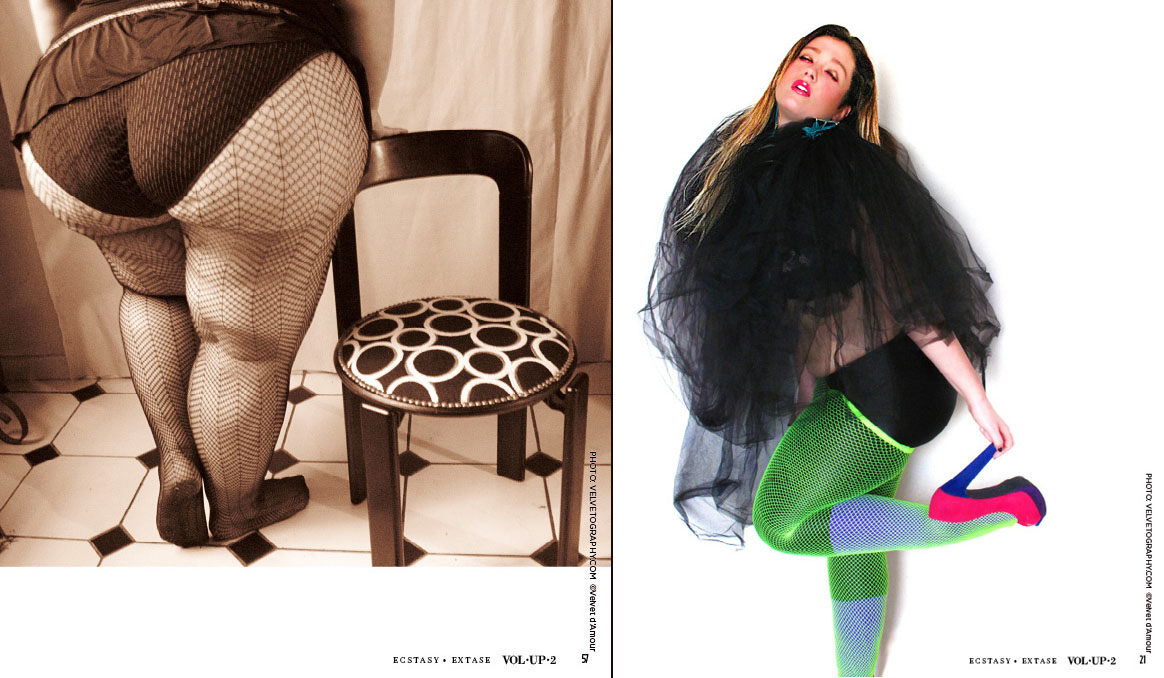
If you learn nothing else today, you will learn (if you didn't know already) how amazing open-work stockings look on fat girls.
Volup 2 is a new magazine from ex-pat American plus-sized model and photographer, Velvet d'Amour. As far as I can tell she had a hand in photographing and styling almost every shoot in all 300+ pages of Volup 2, which she describes as:
I really enjoyed seeing the eye of a fashion photographer brought to bear on fat bodies, and how fat bodies wear clothes, without the usual need to sculpt them with perspective into vague, largish constructions supporting acceptably unfat faces. Her camera is really looking at these plump--fat--thick--bodies. She really wants so know how they look in the clothes they're wearing. It's fun. I don't totally know how I feel about the naked black dude in one of the shoots, but in general I really loved this mag. Nice to see older women and a woman in a wheelchair, too. Often NSFW in delicious ways.
If you learn nothing else today, you will learn (if you didn't know already) how amazing open-work stockings look on fat girls.
Volup 2 is a new magazine from ex-pat American plus-sized model and photographer, Velvet d'Amour. As far as I can tell she had a hand in photographing and styling almost every shoot in all 300+ pages of Volup 2, which she describes as:
A bilingual English/French online quarterly magazine showcasing diverse beauty, with an emphasis on curvy women, and exploring the generosity of Mind, Body and Spirit.D'Amour became famous when she was a 2006 Gaultier runway model and her continuing interest in fashion shows. That is, Volup 2 is a fashion mag--sort of. Fashion, clothes, bodies, makeup, locales. Femmey femme.
I really enjoyed seeing the eye of a fashion photographer brought to bear on fat bodies, and how fat bodies wear clothes, without the usual need to sculpt them with perspective into vague, largish constructions supporting acceptably unfat faces. Her camera is really looking at these plump--fat--thick--bodies. She really wants so know how they look in the clothes they're wearing. It's fun. I don't totally know how I feel about the naked black dude in one of the shoots, but in general I really loved this mag. Nice to see older women and a woman in a wheelchair, too. Often NSFW in delicious ways.
Stay Fatty and Carry On!
T-shirts for sale! White tees go to 5x; dark tees to 3x. Store at Zazzle to come shortly (white tees there go up to 6x).
ahhhhh
What a lovely surprise, while reading a garden-variety health-related piece in a mainstream magazine (February 2012 issue of Martha Stewart Living), this one concerning "The Truth Behind 10 Cholesterol Myths," to come upon a fact that sounded uniquely size-positive for the context. Although really what was so refreshing about it was that it was just information. Not presented as part of any system of thinking about size, not there for any other reason except to sell magazines (basically):
One of the very most worrisome things about size prejudice in the health media is that people DON'T GET THE RIGHT INFORMATION. They are prepped to not get it, or see it, by bigotry. Critics of size acceptance say that fat people are just looking for reasons to "excuse" being fat, or make it okay (let's sidebar that argument for the moment), but seriously--what about the thin person with really high cholesterol who gets a sense it doesn't matter due to the way the issue is sold in the media? Or doesn't check it at all, because they think they don't have to--that only the fatties have heart problems?
We go through this over and over with heart disease in America--everyone's all baffled and surprised when (for instance) a thin, long-time runner like David Letterman needs heart surgery despite major hereditary risks. We're pretty sure we can diagnose disease from looking at people. But that denies the complexities--and complications--of the human body. Whatever size it is.
Information is good. Good job, MStew. Very refreshing!
One of the very most worrisome things about size prejudice in the health media is that people DON'T GET THE RIGHT INFORMATION. They are prepped to not get it, or see it, by bigotry. Critics of size acceptance say that fat people are just looking for reasons to "excuse" being fat, or make it okay (let's sidebar that argument for the moment), but seriously--what about the thin person with really high cholesterol who gets a sense it doesn't matter due to the way the issue is sold in the media? Or doesn't check it at all, because they think they don't have to--that only the fatties have heart problems?
We go through this over and over with heart disease in America--everyone's all baffled and surprised when (for instance) a thin, long-time runner like David Letterman needs heart surgery despite major hereditary risks. We're pretty sure we can diagnose disease from looking at people. But that denies the complexities--and complications--of the human body. Whatever size it is.
Information is good. Good job, MStew. Very refreshing!
Saturday, March 10, 2012
These are double-sided, laminated bookmarks I made around the same time as the button, in the post below, I think (maybe 1999?). There was a template for them in my second 'zine and I still have a big pile of them. I used to slip them into diet books at the bookstore and under the flaps of boxes of diet products. Hee! Naughty. They are fun to carry with you when you are out and want to fight the power. Just a wee bit. With wee sliplets of revolution! I think I may start carrying these again.
Thursday, March 8, 2012
Wednesday, February 1, 2012
Stand Against Weight Bullying
I have been very happy the last couple weeks to donate my Photoshopping time to this project:
...which is one of the organized responses to the Strong4Life campaign in Georgia. It's a project that is trying to reduce rates of childhood obesity with "harsh" (their words) advertising showing chubby children in black and white photos staring sadly into the camera with fat-shaming slogans like: IT'S HARD TO BE A LITTLE GIRL WHEN YOU AREN'T.
That one breaks my heart. How dare they say little fat girls aren't little girls. It's hard not to be mad and heartsick when you see advertising that recreates visually the worst of what it's like to be treated as a fat kid and then tells the kid it's their fault. Basically the campaign is an endorsement of fat prejudice.
I don't know that they're trying to do this--I don't know that they even see that they're doing this (well, now they probably do). I am going to give them the benefit of the doubt at the moment for no other reason that contemplating the opposite makes me exhausted, and note that truly, yea verily, the road to hell is paved with good intentions, and that like many organizations like this--organizations that make heavy-handed mistakes like this--they are probably passionately interested in the health of children. The problem--the dead-end--is tying health to size, full-stop, and working backwards from there. Good health--bad health--health is much more complicated than that. And why is there no concern for thin children who have health problems that may stem from their different diets? And is there anything about this project that would make a fat kid want to run around outside?
It seems like so many conflicts that the people promoting this and the people aghast at it are quite close together, as well as far apart, like the ends of an unclosed circle. If people could set aside the blindness that comes from fat prejudice, there is common ground here. We all want healthy, active kids.
So, the "I STAND" Tumblr and photos (called "STANDards") are one response to all this. They're fun, they're real, they're diverse, they're happy, and they are positive and focused on health. People are smiling! I really like that.
If you'd like to do one yourself email Marilyn Wann at Marilyn@fatso.com with a photo and a short slogan that completes the phrase "I stand...".
Another response to Strong4Life is the fabulous Billboard Project run by Regan Chastain. The idea is to put up positive messages on billboards to counteract the message of Strong4Life in the Atlanta area. Fundraising for this project starts at midnight tonight--here's the link!
In the meantime, some more great STANDards (the first one is Debora Iyall of Romeo Void):
...which is one of the organized responses to the Strong4Life campaign in Georgia. It's a project that is trying to reduce rates of childhood obesity with "harsh" (their words) advertising showing chubby children in black and white photos staring sadly into the camera with fat-shaming slogans like: IT'S HARD TO BE A LITTLE GIRL WHEN YOU AREN'T.
That one breaks my heart. How dare they say little fat girls aren't little girls. It's hard not to be mad and heartsick when you see advertising that recreates visually the worst of what it's like to be treated as a fat kid and then tells the kid it's their fault. Basically the campaign is an endorsement of fat prejudice.
I don't know that they're trying to do this--I don't know that they even see that they're doing this (well, now they probably do). I am going to give them the benefit of the doubt at the moment for no other reason that contemplating the opposite makes me exhausted, and note that truly, yea verily, the road to hell is paved with good intentions, and that like many organizations like this--organizations that make heavy-handed mistakes like this--they are probably passionately interested in the health of children. The problem--the dead-end--is tying health to size, full-stop, and working backwards from there. Good health--bad health--health is much more complicated than that. And why is there no concern for thin children who have health problems that may stem from their different diets? And is there anything about this project that would make a fat kid want to run around outside?
It seems like so many conflicts that the people promoting this and the people aghast at it are quite close together, as well as far apart, like the ends of an unclosed circle. If people could set aside the blindness that comes from fat prejudice, there is common ground here. We all want healthy, active kids.
So, the "I STAND" Tumblr and photos (called "STANDards") are one response to all this. They're fun, they're real, they're diverse, they're happy, and they are positive and focused on health. People are smiling! I really like that.
If you'd like to do one yourself email Marilyn Wann at Marilyn@fatso.com with a photo and a short slogan that completes the phrase "I stand...".
Another response to Strong4Life is the fabulous Billboard Project run by Regan Chastain. The idea is to put up positive messages on billboards to counteract the message of Strong4Life in the Atlanta area. Fundraising for this project starts at midnight tonight--here's the link!
In the meantime, some more great STANDards (the first one is Debora Iyall of Romeo Void):
Labels:
Dances With Fat,
marilyn wann,
Regan Chastain,
Strong4Life
Tuesday, January 31, 2012
all evidence to the contrary
Yes, fat can be healthy. Thin can be unhealthy. So whenever we make assumptions about a person's lifestyle based on weight, we should know that our judgment is really based on aesthetics, not health. If we won't listen to the many fat acceptance experts who have been telling us this for years, maybe we'll listen to a "cute" thin girl whose diet is killing her.An extremely good point--the point about all this stuff, really--from a tight, well-written piece by Amanda Hess about media coverage of Stacey Irvine, a girl in England who's eaten nothing but chicken nuggets and fries from McDonald's for years and is now suffering anemia and other problems. Cultural bias is so strong that the assumption Irvine is fat persists even though all the articles show photos of her. She's thin.
People seem to be clucking in bemused shock at her. Does seriously nobody care about unhealthy thin children? This worries me as much as the way fat kids are treated.
Friday, January 27, 2012
hey Paula
![]() |
| photo accompanying People poll |
What's to say? She has diabetes. Kinda awful. The story, like all of these news stories with huge amounts of traction, represents a challenging test case of our feelings. In this country we really love issues when they are attached to one person, preferably in some intense form. With all the variables ratcheted up. That's how we like to shape our discussions of issues. We think we can solve them if we crack the dilemmas one person embodies. Except of course, they're not solvable that way--you don't "solve" issues looking at individual people.
Anyhow, I saw this today on People's home page (what, was I not going to click on it?):
It occurs to me that what is so wrong with this may not leap out at everybody, but the reason I'm finally blogging about this little chapter in the whole PD story is HELLO WE DON'T AND IN FACT SHOULD NOT HAVE ANY INPUT IN WHAT SHE OR ANYBODY ELSE EATS LAY OFF WHO CARES NONE OF OUR BEEZWAX.
She is a person engaged in the ugly business of money and celebrity, and that makes it hard to see where the boundaries are, and yes that Krispy Kreme burger she made on her show sure looks gluttonous, and yes it's all kinda sticky, but that question above shouldn't be asked. It scares the hell out of me in some ways to see it put as baldly as that.
When you click on the poll, these are the two options:
--which at first make the whole thing look better, but there is ultimately no difference between the two. Either way--she shouldn't eat hamburgers or she can enjoy the occasional burger--we're telling her what to do.
Plus--are we saying if she gorged in private then it'd be okay? (Since this is about appearances and setting examples.) Or if she starved herself? How will we be sure she is only occasionally enjoying a burger? Are we planning on photographing her every time she eats? Will we know by whether or not she is thinner? Are we getting her A1c numbers and fasting glucose levels?
Modern celebrity being what it is--we might see those numbers. She might show us these numbers. And she will from now on probably get photographed every time she eats in public. She may involve us in all this á la Kirstie Alley and Wynonna Judd and people like that--make us complicit via the media in her weight guilt or struggles or angst or do the opposite and dive into a chocolate trifle on TV (although I think Deen actually has some decent boundaries in amongst all this murkiness, weirdly). But you know what, we don't get to tell anybody what to eat. We just don't.
I think the issue in this case is a lot about seeing her eating. It's one thing to talk about it, but to actually see it seems to spark visceral reactions in people (and in People!). To me this reaction feels instinctively connected to the way fat people are often effaced and desired to be invisible in public and in the media. Because if a fat body is Wrong, then you're just kinda supposed to hide until it's Right. Kind of like--you go home and fix that, and then you can come back. You may be begrudgingly allowed out in the meantime, but if you're seen doing something to make it Wronger, especially eating--something that people are dead sure is making it more Wrong--then you are violating an unspoken contract with the world.
I know this sounds melodramatic, but think about it: If your body is wrong, and you caused it, how are you allowed to exist--to be seen, which is the same thing in the media--right now? In what way? Eating what? The only way you're 'allowed' to be fat with any approximation of autonomy is if you are shown to be trying to change it--or if you at least aren't seen doing things that everyone is quite sure make fat happen (like eating a hamburger). Then the criticism is held off just a little. At a fundamental cost, of course, because you must always make it clear first you don't like your body either. But if you don't do this...all bets are off. The world's going to go get the belt.
The other day somebody posted this comment by her sister on her Tumblr page: "I think people who don’t actively try to lose weight should be euthanized." People have posited that fat children should not be given food stamps, because "they've already had enough food." That's what I'm talking about. These horrible sentiments are nothing more than the usual thinking--all the much nicer, concern-trolly versions--taken to their logical ends.
Anyhow. I certainly won't solve anything by writing about her either, but I do wish people would back off.
As of right now, by the way, these are the results of the poll. I guess if one of them has to be 84%, might as well be #2.
Labels:
kirstie alley,
paula deen,
people magazine
Tuesday, January 24, 2012
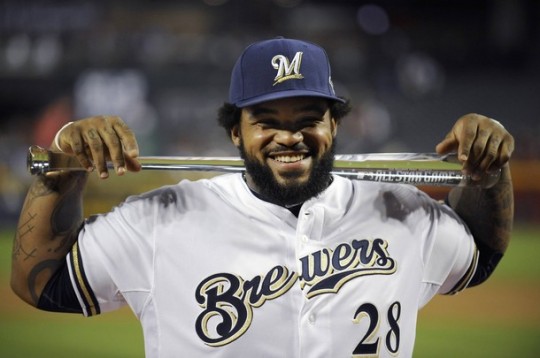
Prince Fielder!
Such a great name (and such a great name for a baseball player).
The dude signed an enormous contract for the Tigers today, but the thing that caught my eye were these old photos, posted by the Twitter account @si_vault (complete with a little fat-bashing--of a little kid--yay), which showcases photos of athletes from the Sports lllustrated archives. Here is a young Prince Fielder, shown in two of the photos with his father, former MLB and Tigers player Cecil Fielder (how cute is that first one of him at 9 years old):
Sports journalism being the obsessive thing it is, I am sure Fielder's size has been examined all to hell and back. That's basically how I know his name, from it popping up in conjunction with "too fat?" discussions. (One description of him from The Hardball Times: "Up close, compared to his teammates, he looked like a man among boys. His arms were bigger than my thighs, but he didn't look fat--he just looked huge.")
The thing I think looking at these photos today, when we live with so much emphasis on and hysteria about childhood size, is: how should the world treat kids like him? How did the world treat that kid? Did his family/his dad know he could be a great athlete and more or less let him be himself--let that body be the one he became a great athlete in? How much did he have to fight to become who he was?
A fat, talented kid like that these days--I'm not sure he would have been left alone. I'm not talking about the bullying aspect: he would be put on diets, and sent home from school with notes for his family, and tsked at in various ways. All that stuff happened when I was a kid, and when he was a kid, but without quite the large-scale institutional hysteria that informs most aspects of our discussions of children and food now--the constant chorus of childhood-obesity-childhood-obesity.
You can't know what that kind of stuff will do to a child, but I do know that it usually increases your chance of being fatter, of developing an eating disorder, of yo-yo dieting. How much does our emphasis on size over health interfere with kids becoming who they might be? Is it okay that this little dude grew up to be a famous fattish athlete? Is being a fat child so bad that it is worth the risk of taking away what he might become on the chance you might get him thinner now? Temporarily.
The dude signed an enormous contract for the Tigers today, but the thing that caught my eye were these old photos, posted by the Twitter account @si_vault (complete with a little fat-bashing--of a little kid--yay), which showcases photos of athletes from the Sports lllustrated archives. Here is a young Prince Fielder, shown in two of the photos with his father, former MLB and Tigers player Cecil Fielder (how cute is that first one of him at 9 years old):
Sports journalism being the obsessive thing it is, I am sure Fielder's size has been examined all to hell and back. That's basically how I know his name, from it popping up in conjunction with "too fat?" discussions. (One description of him from The Hardball Times: "Up close, compared to his teammates, he looked like a man among boys. His arms were bigger than my thighs, but he didn't look fat--he just looked huge.")
The thing I think looking at these photos today, when we live with so much emphasis on and hysteria about childhood size, is: how should the world treat kids like him? How did the world treat that kid? Did his family/his dad know he could be a great athlete and more or less let him be himself--let that body be the one he became a great athlete in? How much did he have to fight to become who he was?
A fat, talented kid like that these days--I'm not sure he would have been left alone. I'm not talking about the bullying aspect: he would be put on diets, and sent home from school with notes for his family, and tsked at in various ways. All that stuff happened when I was a kid, and when he was a kid, but without quite the large-scale institutional hysteria that informs most aspects of our discussions of children and food now--the constant chorus of childhood-obesity-childhood-obesity.
You can't know what that kind of stuff will do to a child, but I do know that it usually increases your chance of being fatter, of developing an eating disorder, of yo-yo dieting. How much does our emphasis on size over health interfere with kids becoming who they might be? Is it okay that this little dude grew up to be a famous fattish athlete? Is being a fat child so bad that it is worth the risk of taking away what he might become on the chance you might get him thinner now? Temporarily.
always having the wrong reaction
This billboard--yes, you would see this driving down the street--is from the Physicians Committee for Responsible Medicine, who advocate a vegan diet and are targeting dairy products as a major contributor to body size.
I think we're supposed to be appalled by the butt, but all I could think was--wow, what a fabulous ass. Plus the hands squeezing the hips add to the overtly sexual nature of the image. I guess it's supposed to be a doctorly squeeze of the fat, though.
Are fat bodies so devoid of sexuality in the minds of the advertising agency/PCRM that this image is in their minds completely clinical? And can be used--negatively--to shame people? PCRM must think so, but the billboard that resulted is a bizarre kinky mess of shame, sex, hate, and dehumanization. They don't know what they're doing.
p.s. Some vegans are fat. Just sayin.
p.p.s. Thanks to The Society Pages for the article above (worth clicking).
women's sumo
How cool is this lady? (Even if the Daily Mail's hook is the calories she gets to eat, whoopdeedoop*.) She looks very strong. I'm not sure I knew or remembered that there even is women's sumo wrestling, but--neato.
*Ah, the Daily Fail. Where would we be without it? Although really, because that paper is an absolute shitstorm of obsession with the female body it can be strangely inclusive compared to other media in its coverage. At least you actually see different kinds of bodies: fat bodies, thin bodies, old bodies, whatever. You see them with crazy judgmental, hostile, sexist commentary attached--but you see them.
Monday, January 23, 2012
Miss. Etta. James.
This was the first time I saw Etta James, in Hail! Hail! Rock 'n' Roll (1987), a tribute to Chuck Berry on his 60th birthday. I remember I was shocked at the sight of a big woman singing like that, shaking her ass and taking the stage for her own. It's cool to watch and in 2012 still seems kind of bold and unusual. She's really big, she's really moving, she's really good at it. I wish I could have seen her in action more. And heard her (apparently) fantastically nasty stage patter.
I have been reading snippets of her autobiography via GoogleBooks and here is something she wrote about that:
Fans will see me kicking off my shoes and stomping on stage, turning my back, sticking out my big butt and shaking it like a fool. I'll rub my hands all over my body, roll my tongue, and play the slut. Been doing that shit for years. Why? I'm conflicted. Sometimes when I sing live, I feel like the devil gets in me. I want to scandalize the squares; I want to be bad. I'm defiant. I know people are thinking--man, that woman is fat!--and I want to show 'em right off that I don't give a shit.
But I do. I feel like the clown. I feel the humiliation every fat person feels. I get tired of treating myself like some joke. The joke, you see, is my way of hiding pain. It's protection. And it feels like punishment.Depending on which obituary you read, the gastric bypass surgery James in 2002 had either created complications that contributed to her death or saved her life (maybe both, eh?). I wouldn't know. She wasn't a clown, though. She may have felt like one sometimes, but from where we sit, she wasn't. She was fantastic.
the singing at 3:30 - 3:50 kills me:
ADDENDUM: This is a fabulous obituary I hadn't read when I posted the above. By Kenyon Farrow.
Tuesday, December 20, 2011
Why Women Need Fat - will repost soon
ERRATUM: I need to more carefully reframe what it was I liked about this article--will repost soon.
Labels:
salon,
Steven Gaulin,
why women need fat,
William Lassek
Monday, December 19, 2011
have a fattastic 2012
There are two--TWO--fantastic fat-themed calendars to hang, flip the pages of, or scrabble on, in 2012. Yeah, I'm dangling my prepositions!
1) The Adipositivity Project wall calendar (11"x17")--twelve months of arty, nsfw, fat lady visuals. Beautiful photography and a worthy, exciting project, as always. I was honored to make a minor contribution to their holiday message.
2. The Fat!So? dayplanner--a cover to decorate yourself, and double pages inside with tips, quotes, images, drawings, and dates to help inform a size-positive year, from Marilyn Wann and others. Here is a brief video showing the book. Proceeds go to build the Weight Diversity Action Lounge, a community center in the SF-area.
1) The Adipositivity Project wall calendar (11"x17")--twelve months of arty, nsfw, fat lady visuals. Beautiful photography and a worthy, exciting project, as always. I was honored to make a minor contribution to their holiday message.
2. The Fat!So? dayplanner--a cover to decorate yourself, and double pages inside with tips, quotes, images, drawings, and dates to help inform a size-positive year, from Marilyn Wann and others. Here is a brief video showing the book. Proceeds go to build the Weight Diversity Action Lounge, a community center in the SF-area.
on NHANES and data-gathering
Worth reading: this recent interesting post from an interesting blog by Kjerstin Gruys, who is spending a year not looking in mirrors and writing about the experience. Gruys details participating in the CDC National Health and Nutritional Examination Survey (NHANES) and what it was like to have such detailed information taken and given about her health, especially as a former anorexic.
The part that really leapt out at me was this fascinating paragraph about (basically) the framework within which the CDC is collecting information about weight and food, and how the way it is designed will never allow a full picture [emphases are mine]:
. . . I can honestly say that the NHANES study seems to be biased toward preventing weight gain, as opposed to preventing eating disorders. My first clue didn't come on my "Preliminary Report of Findings" but in the wording of one of the interview questions asked during our home visit. The field interviewer asked me if I'd "ever participated in any weight-loss diets". My answer was "yes." Then she asked me, "How much weight did you lose in your most successful weight-loss attempt?" The NHANES computer program only allowed her to record the (horrifying and unhealthy) amount of weight that I'd lost in my most "successful" attempt, but there was no space to specify that "it was due to anorexia and she could have died." Upon my urging, she added a special note, but I have no idea how this will be handled when the data are analyzed. This is troubling: the wording of this question frames any weight loss as good, which we know isn't true. Another thing I noticed: despite asking me to describe, in detail, every bite of food that I'd eaten in the prior 24 hours, I was never asked whether I'd purged any of this food, or if I had taken laxatives or diuretics (I hadn't, but that's not the point). Through these questions (and non-questions), some of the most dangerous health behaviors - such as crash-dieting, purging, laxative abuse, and extreme food restriction - are made invisible.Worth a read. Thoughtful post.
Wednesday, December 14, 2011
good quote on the Jessica Simpson blah-blah
This article in Slate about Jessica Simpson's possible pre-birth signing with Weight Watchers for post-birth weight loss endorsement sums up the whole game really well:
This . . . body-policing cycle—weight gain, scrutiny, weight loss, more scrutiny, repeat—that is one of the most powerful motors in the machinery of celebrity journalism. No celebrity can ever achieve the right weight, because there is no right weight; one is always too fat or too skinny, and one is always eating too much or too little. There’s no escape. There is only—for the publications that sell copies by stoking readers’ body anxieties, for the celebrities who manage to ink multimillion-dollar weight-loss deals, and for the diet companies that rake in consumers’ cash—profit.In fact, this piece points out that Simpson—or her handlers—or the machine—whatever—may be encouraging a bidding war by placed items about her weight gain/prenant eating habits. The real fuel of people's pain and worry makes this industry possible, but it feels like money will never let it stop.
Labels:
jessica simpson,
slate,
weight watchers
Sunday, December 11, 2011
Weight Loss and Sexual Reorientation in Evangelical America
This book by Lynne Gerber, Seeking the Straight and Narrow, looks fascinating. From the U of Chicago Press website:
Drawing on fieldwork at First Place, a popular Christian weight-loss program, and Exodus International, a network of ex-gay ministries, Lynne Gerber explores why some Christians feel that being fat or gay offends God, what exactly they do to lose weight or go straight, and how they make sense of the program’s results--or, frequently, their lack. Gerber notes the differences and striking parallels between the two programs, and, more broadly, she traces the ways that other social institutions have attempted to contain the excesses associated with fatness and homosexuality. Challenging narratives that place evangelicals in constant opposition to dominant American values, Gerber shows that these programs reflect the often overlooked connection between American cultural obsessions and Christian ones.
How Glad I Am!
How can you not like this song? This version of this song, I mean.
I always think there's an unintentional dash of size love in the lyrics, somehow. And her version is so crisp and happy, so Nancy Wilson.
My love has no beginning, my love has no end
No front or back and my love won't bend
I'm in the middle, lost in a spin loving you
And you don't know, you don't know
You don't know, you don't know how glad I am
My love has no bottom, my love has no top
My love won't rise and my love won't drop
I'm in the middle and I can't stop loving you
And you don't know, you don't know
You don't know, you don't know how glad I am
I wish I were a poet so I could express
What I'd, what I'd like to say yeah
I wish I were an artist so I could paint a picture
Of how I feel, of how I feel today
My love has no walls on either side
That makes my love wider than wide
I'm in the middle and I can't hide loving you
And you don't know, you don't know
You don't know, you don't know how glad I am
I always think there's an unintentional dash of size love in the lyrics, somehow. And her version is so crisp and happy, so Nancy Wilson.
My love has no beginning, my love has no end
No front or back and my love won't bend
I'm in the middle, lost in a spin loving you
And you don't know, you don't know
You don't know, you don't know how glad I am
My love has no bottom, my love has no top
My love won't rise and my love won't drop
I'm in the middle and I can't stop loving you
And you don't know, you don't know
You don't know, you don't know how glad I am
I wish I were a poet so I could express
What I'd, what I'd like to say yeah
I wish I were an artist so I could paint a picture
Of how I feel, of how I feel today
My love has no walls on either side
That makes my love wider than wide
I'm in the middle and I can't hide loving you
And you don't know, you don't know
You don't know, you don't know how glad I am
Wednesday, November 30, 2011
my dinner with @robdelaney
Nah--not dinner, a seven-tweet exchange. Which he thoughtfully deleted on his end, so as to keep his kooky followers (wait, that's me!) from targeting me as a civilian.
I love reading Rob Delaney on Twitter, as do many other people--as of this exact moment, 257,212 other people, which is maybe 200K more than when I first started following him. (I cite this not as hipster cred but to show how fast things can change on Twitter. Tis bonkers.)
If you already follow him you probably get the appeal of his funny and nsfw feed (watch as I make it unfunny with a little sketchy analysis), which more than many uses the tools that only 140 characters allow, including lots of change in voice and tone using punctuation, spelling, and length, doing stuff like: responding to fake tweets he's made up (Barack Obama) or to real tweets from dumb corporate/celebrity feeds (Kim K); employing a great sense of the goofy and macabre; showing a strong, sincere POV about politics, shitty popular culture, and dumb women's beauty ideals, which shines through in all the fun, nasty tweets. I can't sum up his tweetin' in one paragraph, but it's really fun, and worth a surge through it, as is the stuff he writes for Vice. He's smart. He doesn't ha-ha at his written jokes--just lets them rip.
He often talks about liking chubby women (see category "he likes it sturdy," here), which is always what makes it an extra-bummer to see guys like that draw that line where "fat" becomes a lazy, meaning-packed diss. They just move the line over a little, a distinction that people in their preferences always seem to need to define by talking about how gross the things they don't like are.
I think I'd responded to one of his "fat" tweets before, but in October I tossed another response at him (first thing in the morning, bleary-eyed, unthinking) because of the first tweet below, here, and then had the following exchange:
Who knows if he actually thought about what I said. "Fat" still pops up in his tweets in kinda meh ways. It must be such a temptation to use that word, especially in that context--three words of great power and connotation--although to me it means only one thing. I don't mean that in any kind of ennobled way! This is not about being PC. It's just that all the word describes is body size...that's it. Any other meaning is long gone for me, to the point that when other people use it I can feel confused at first. He's right--it is lazy to use it as a descriptor, because it doesn't mean nearly as much as people think it does, which also makes it misleading. And confirms its general role as an insult. And he didn't need to mention that his weight fluctuates (inasmuch as it's relevant, which it isn't)--everyone in America has issues about size, otherwise people wouldn't be so fucked up and mean about it to other people.
But I quite appreciated him writing back (and quickly deleting the posts). It was very exciting and I do think he was a mensch for doing it. And I love his ballsy way of using the space he has on Twitter--opening up a lot of space with his jokes, especially by being both raunchy and real (ungh, why are the words describing nsfw humor so humorless) and sort of feminist at the same time. Which was why it was a bummer to see him patting prejudice into place using "fat" the way he did, but you know--Twitter goes by fast. Things change fast too. Who knows.
ADDENDUM: I forgot to mention that the day after our interchange, this piece by Delaney appeared on the Vice website: "I Fuck Food." Which is a phrase from this blog--I used it in an entry about Bridesmaids: ". . . a lame sight gag involving a sandwich that makes it clear that people think fat people fuck food, not people." Simultaneous genius?
I love reading Rob Delaney on Twitter, as do many other people--as of this exact moment, 257,212 other people, which is maybe 200K more than when I first started following him. (I cite this not as hipster cred but to show how fast things can change on Twitter. Tis bonkers.)
If you already follow him you probably get the appeal of his funny and nsfw feed (watch as I make it unfunny with a little sketchy analysis), which more than many uses the tools that only 140 characters allow, including lots of change in voice and tone using punctuation, spelling, and length, doing stuff like: responding to fake tweets he's made up (Barack Obama) or to real tweets from dumb corporate/celebrity feeds (Kim K); employing a great sense of the goofy and macabre; showing a strong, sincere POV about politics, shitty popular culture, and dumb women's beauty ideals, which shines through in all the fun, nasty tweets. I can't sum up his tweetin' in one paragraph, but it's really fun, and worth a surge through it, as is the stuff he writes for Vice. He's smart. He doesn't ha-ha at his written jokes--just lets them rip.
He often talks about liking chubby women (see category "he likes it sturdy," here), which is always what makes it an extra-bummer to see guys like that draw that line where "fat" becomes a lazy, meaning-packed diss. They just move the line over a little, a distinction that people in their preferences always seem to need to define by talking about how gross the things they don't like are.
I think I'd responded to one of his "fat" tweets before, but in October I tossed another response at him (first thing in the morning, bleary-eyed, unthinking) because of the first tweet below, here, and then had the following exchange:
Who knows if he actually thought about what I said. "Fat" still pops up in his tweets in kinda meh ways. It must be such a temptation to use that word, especially in that context--three words of great power and connotation--although to me it means only one thing. I don't mean that in any kind of ennobled way! This is not about being PC. It's just that all the word describes is body size...that's it. Any other meaning is long gone for me, to the point that when other people use it I can feel confused at first. He's right--it is lazy to use it as a descriptor, because it doesn't mean nearly as much as people think it does, which also makes it misleading. And confirms its general role as an insult. And he didn't need to mention that his weight fluctuates (inasmuch as it's relevant, which it isn't)--everyone in America has issues about size, otherwise people wouldn't be so fucked up and mean about it to other people.
But I quite appreciated him writing back (and quickly deleting the posts). It was very exciting and I do think he was a mensch for doing it. And I love his ballsy way of using the space he has on Twitter--opening up a lot of space with his jokes, especially by being both raunchy and real (ungh, why are the words describing nsfw humor so humorless) and sort of feminist at the same time. Which was why it was a bummer to see him patting prejudice into place using "fat" the way he did, but you know--Twitter goes by fast. Things change fast too. Who knows.
ADDENDUM: I forgot to mention that the day after our interchange, this piece by Delaney appeared on the Vice website: "I Fuck Food." Which is a phrase from this blog--I used it in an entry about Bridesmaids: ". . . a lame sight gag involving a sandwich that makes it clear that people think fat people fuck food, not people." Simultaneous genius?
"It's that fat lady from the station!"
A lady needs tools in her self-esteem arsenal, yes? Of all kinds?
I like to collect and savor moments that demonstrate (a sometimes delightfully unexpected) admiration for fat women in movies or TV (or paintings or books or). Earlier in my life I think I used to snatch at them, really--as evidence of something I wasn't quite sure existed--but regardless, I am still now, as then, ever on the lookout for bits of culture that praise or otherwise provide an appreciation of the larger lady. They are fun.
As such, I offer up a scene from Where Angels Fear to Tread (1991), a rather chaotic adaptation of the novel by E.M. Forster. It is one of those stories that shows horrid English people doing horrid things in Italy (and how), which opens their insides up and teaches them how to be otherwise, although it may be too late? Yes? No?
Earlier in the film, the exceedingly horrid Harriet Herriton (played fearlessly by Judy Davis) and her brother Philip (Rupert Graves) have bumped into a woman (Evelina Meghnagi) on the train and rudely pushed her out of the way [see above stills]. After disembarking they all end up waiting in the sun at the same train station in Monteriano, where the fat woman, whose conversational advances Harriet has cut, is unaccountably (to Harriet) picked up first by the pleased driver.
Later, Harriet, Philip, and Caroline Abbott (Helena Bonham-Carter), attend a performance of Lucia di Lammermoor and discover that the woman they were traveling with is fact the star of the production ("It's that fat lady from the station!"). She sings the mad scene from Lucia ("She's sure to be very vulgar," says Harriet) as the Italian audience--mostly men, and mostly rather swain-like--sit rapt and silent before breaking into crazy applause at the end (and Philip climbs the balcony to meet the man they've come to Italy to see, as if he's leaving his own culture and joining theirs). I was enchanted by this scene when I first saw it. There's a nice little bit of comeuppance in it, as well as the fun of seeing a room full of Forster's Italians swoon over the singer. Enjoy!
I like to collect and savor moments that demonstrate (a sometimes delightfully unexpected) admiration for fat women in movies or TV (or paintings or books or). Earlier in my life I think I used to snatch at them, really--as evidence of something I wasn't quite sure existed--but regardless, I am still now, as then, ever on the lookout for bits of culture that praise or otherwise provide an appreciation of the larger lady. They are fun.
As such, I offer up a scene from Where Angels Fear to Tread (1991), a rather chaotic adaptation of the novel by E.M. Forster. It is one of those stories that shows horrid English people doing horrid things in Italy (and how), which opens their insides up and teaches them how to be otherwise, although it may be too late? Yes? No?
Earlier in the film, the exceedingly horrid Harriet Herriton (played fearlessly by Judy Davis) and her brother Philip (Rupert Graves) have bumped into a woman (Evelina Meghnagi) on the train and rudely pushed her out of the way [see above stills]. After disembarking they all end up waiting in the sun at the same train station in Monteriano, where the fat woman, whose conversational advances Harriet has cut, is unaccountably (to Harriet) picked up first by the pleased driver.
Later, Harriet, Philip, and Caroline Abbott (Helena Bonham-Carter), attend a performance of Lucia di Lammermoor and discover that the woman they were traveling with is fact the star of the production ("It's that fat lady from the station!"). She sings the mad scene from Lucia ("She's sure to be very vulgar," says Harriet) as the Italian audience--mostly men, and mostly rather swain-like--sit rapt and silent before breaking into crazy applause at the end (and Philip climbs the balcony to meet the man they've come to Italy to see, as if he's leaving his own culture and joining theirs). I was enchanted by this scene when I first saw it. There's a nice little bit of comeuppance in it, as well as the fun of seeing a room full of Forster's Italians swoon over the singer. Enjoy!
Labels:
media,
opera,
Where Angels Fear to Tread
Tuesday, November 15, 2011
what a twit
From the Gordon Ramsey interview in October UK edition of Playboy. Credit to Playboy for the extremely stupid question about the nature of being a chef, and to Ramsey himself for the asshole answer, which has SWEETFUCKALL to do with cooking (interesting to contrast his with the "never trust a skinny chef" dictum, which was also assholely). Also, credit to both of them for barging ahead immediately afterward with the idiom "spreading yourself thin" in a way that to me adds extra Duh to his already specious thinking about the phenom of the chef brand:
Q8 PLAYBOY: How do you not weigh 300 pounds?
RAMSAY: I like the Chinese ethic of eating four or five small bowls a day. I don’t think chefs should be fat. I was a fat chef once. I think it’s the most disgusting trait for any chef to walk into a dining room at 450 pounds and expect people to eat his or her food. My father died of a heart attack at the age of 53. I’ve never smoked in my life. I love keeping fit. I don’t like sitting around.
Q9 PLAYBOY: Clearly not. You have more than two dozen restaurants around the world, three TV shows here and three in the U.K., cookbooks, promotional tie-ins, four young kids. Do you ever worry you’re spreading yourself too thin?
RAMSAY: Oh, come on. Do you think Wolfgang Puck has spread himself too thin with Puck Express and a $400 million company? Fuck no. For a guy with 127 restaurants, he looks great and he’s cool as a cucumber. I can only hope to continue at that level at 62. But he does it the same way I do it and the same way Thomas Keller or Joël Robuchon or any other great chef does: You hire great people.
Tuesday, October 18, 2011
photo Tuesday - NSFW
The bottom pic has been making the rounds on Tumblr, which led me to look at the artist's website. There's some other interesting stuff on it. This is not a whole-hearted endorsement, btw--the dick-worshipping pic on the front page right now is kind of hilarious, and you could argue that the bottom pic is problematic--but still--interesting.
Saturday, October 15, 2011
Never read the comments.
This time I read the comments. Dumb me.
My friend Lorna (the gorj redhead) was featured in this piece in the Daily Mail (the Daily M being its own problem, yes), and for some reason I let my eye drift to the land of text AT THE BOTTOM. Never do that.
What struck me this time, in addition to the usual sneering, bottomless derision, was how goddamn sure commenters--especially the concern-trolling commenters, who make sure they check anybody's perceived complacency with their size (they can identify this by a lack of proper self-hate) before it goes too far with medical "concerns"--how goddamn sure they are that they KNOW EVERYTHING.
It's almost funny. They know why a group of people or in an fact any one person is fat, how they live, who will get diabetes, who is paying for fat people's drain on the economy (them). They know a fat person's psychology, medical history, test results, future, past, state of being--all from looking at a 5" square 72 dpi photo online with some accompanying shitty prose. They are there to make sure we all know what they know. It's even more ridiculous when you know the commenter is a grossed-out 18-year-old who is so incredibly sure about this stuff. The 18-year-olds don't sound any different from the crazed adults, actually. Which should tell us something.
I think it would be great if commenters had to include the unspoken part of their concern-trolling (in brackets):
Never read the comments.
My friend Lorna (the gorj redhead) was featured in this piece in the Daily Mail (the Daily M being its own problem, yes), and for some reason I let my eye drift to the land of text AT THE BOTTOM. Never do that.
What struck me this time, in addition to the usual sneering, bottomless derision, was how goddamn sure commenters--especially the concern-trolling commenters, who make sure they check anybody's perceived complacency with their size (they can identify this by a lack of proper self-hate) before it goes too far with medical "concerns"--how goddamn sure they are that they KNOW EVERYTHING.
It's almost funny. They know why a group of people or in an fact any one person is fat, how they live, who will get diabetes, who is paying for fat people's drain on the economy (them). They know a fat person's psychology, medical history, test results, future, past, state of being--all from looking at a 5" square 72 dpi photo online with some accompanying shitty prose. They are there to make sure we all know what they know. It's even more ridiculous when you know the commenter is a grossed-out 18-year-old who is so incredibly sure about this stuff. The 18-year-olds don't sound any different from the crazed adults, actually. Which should tell us something.
I think it would be great if commenters had to include the unspoken part of their concern-trolling (in brackets):
I know your fat will make you diabetic [because I am the wizard of diabetes future!]Anyhow: ungh. And: hehe. Vent over.
I hate to tell you but [I am an MD because I am online and I can diagnose illness from online photos and] you are unhealthy because you're fat
You are promoting obesity by showing [and not flagellating] these fat women [who using my logic aren't really people at all]
I don't believe you are happy at your size [because you shouldn't be and I will keeping treating you like shit until you realize you this]
I appreciate fat acceptance but there is a line between curvy and unhealthily obese [and I can tell where it is by when my dick gets soft]
I know that if you ate less and exercised more you'd be happier [because I AM SUPERMAN & I CAN SEE WHAT YOU EAT WITH MY X-RAY SPEX!!]
Never read the comments.
Subscribe to:
Posts (Atom)