Tuesday, March 19, 2013
Sunday, March 17, 2013
supporting *everyone* in adopting good health behaviors
I always appreciate reading Linda Bacon on health and size (emphasis is mine):
Ernest: So what are the real parameters determining one’s health?
Linda: My main goal is to take weight out of the equation, recognizing that its value has been exaggerated as a health indicator, and that we’ll get much better information from attentiveness to other, better-established, health indicators, such as glucose sensitivity. I’d rather re-frame your question to put our focus on supporting everyone in adopting good health behaviors. This would be of great benefit to everyone, regardless of whether one is big or small, has trouble with glucose regulation or not. If our focus is on fat, we miss diagnoses in thinner people, who may suffer from the diseases we blame on fat, and we pathologize fatter people, despite the fact that many of them are not, nor will they be, sick.
Tuesday, March 12, 2013
the soda ban and a personal animus
Mayor Bloomberg's soda ban was struck down this week in New York. For the moment, at least. I feel this was the right thing to do, and the judge's ruling that noted the "arbitrary and capricious" nature of the particulars of the ban was spot-on. There are nasty implications in attempting to affect public health - by which Bloomberg means obesity - in this way.
But here's the thing: I have come to find soda kind of evil, a word that I never use about food. I understand the urge to want to slap it back. I can't override my animus toward it, even though I like to drink it sometimes. This is my bias.
I try really hard not to extrapolate anecdotally from my own experience with regard to food and health. If you pay any attention in life, you see that even with some large-scale patterns, everyone's body is a different machine, responding differently to meds, foods, sleep, movement, emotion, temperatures . . . everything. I can't assume my experiences are anybody else's. And (to be brief) I find a lot of talk about nutrition exhaustingly prescriptive and rigid, when it's not overtly paranoid and moralizing; that's all nutrition, good and bad, even with interesting and compelling facts about the science of junk foods. But given my own point of view I am still closer to having the same urge to cap off soda serving sizes that Bloombergians do than I am than in regard to any other food and public health topic.
I love cold clear sweet things, by the way; I think I have an especially strong cold sweet tooth, in fact. I love granita, sorbet, Popsicles, unsweetened juice bars, Italian ice, all-fruit smoothies, Pop-Ice, slushy frozen fruit juice, good sugar-based sodas of all kinds, all of it. I often order sorbet at ice cream stores, which people treat as if I'm denying myself (I have problems with lactose, but that's not usually why I order sorbet). One of my happiest eating experiences recently was just a black cherry soda over ice at a diner. I can't even describe how good it tasted with my food, how satisfying it was. Seriously, a good soda is a beautiful thing. There is an itch that gets scratched when something sweet and cold goes down your throat that nothing else can do. I think it's a travesty to not have a cold soda to drink with your pizza. Nothing soothes my tum like ginger ale or cola syrup.
But I don't think soda - the kind with high-fructose corn syrup - is evil because it's delicious and tempting, I find it evil ultimately because it tempts but does not deliver. It has a sorcerer's apprentice quality. You reach for it to slake your thirst and hit those sweet (hah) spots (ahh) in your throat only to find that afterward you're thirstier than you were before and want another. It doesn't end. It's like a weird curse in a fairy tale. In my experience there's no off button with soda, no click of satisfaction, like it's not really food. It doesn't ever really fill you, except in uncomfortable ways. It doesn't really satisfy, except in an initial rush of sensation - you end up chasing the dragon. It's good at washing things down, but that's about all it does really well in quantity.
I don't have the same experience with Mexican Coke (made from sugar) that I do with regular Coke (made with HFCS). I may want more than my stomach does, but I do get to the point of "ahhh," rather than wandering further and further afield from it. Honestly, anything with HFCS as a major sweetener, like Slurpees, makes me feel only thirstier and more unsatisfied. I haven't drunk diet soda that often, but my impression is that the Off Button with diet soda is even farther out of reach. No Ahhh there. And maybe even more of that almost salty feel on your tongue that makes you want more.
Sometimes I wile out over soda and drinks tons of it. But in general I try to shape my consumption, as much as I can, to really enjoy it when I drink it and to drink the amount I want: treat it less like a beverage and more like dessert. Then it tastes much better. But that can still be difficult. When I go to fast food places I usually order a small soda, but about half the time they bring me a large anyhow. (Can you imagine that happening with any other food or beverage?). Or I ask for a cup or glass to be half-filled at a regular restaurant, and am handed a glass that's filled all the way. (Sometimes I ask for this too because I get tired of spilling glasses of soda; it's like there's a law it has to be filled to overflowing.) On planes I ask for the cup to be half-filled, which is a hassle to remember, I know, but it is still pretty hard to get them to do it. Or at a restaurant with free refills I have to say to the waiter over and over NO, please, don't refill my glass.
I have had a lot of experiences with restaurants thrusting way more soda at me than I was asking for. When you are trying to drink a small quantity of it you do get a window into how people really do expect huge quantities of it. It's hard to turn off the blast. So I get the urge to want to slow it down.
I also think there are a lot of dangerous paths you can start trekking when looking at processed food, paths that end up obsessively demonizing it, ratcheting up its appeal and power, giving us fewer tools to navigate the food world that's out there. And I don't agree with Bloomberg's "obesity kills" M.O. of slapping drinks out of people's hands - he sounds less concerned with the health effects of soda than with an oversimplified parity between health and size that makes me tremble for the fat kids of New York and more misguided policies they will be facing. Fat kids - and the thin kids who will be presumed to be safe from such effects.
But I do think soda is kind of - evil. I can't get past my own feelings about it, can't help remembering my own experiences with it that just never seemed to end. It seems like the perfect drink for a world where we devise tortures for ourselves about food: stapling stomachs so that we can't absorb nutrients, living in fear of foods and our hungers, starving even when amidst plenty, always wanting more, not believing we can have or want satisfaction.
But here's the thing: I have come to find soda kind of evil, a word that I never use about food. I understand the urge to want to slap it back. I can't override my animus toward it, even though I like to drink it sometimes. This is my bias.
I try really hard not to extrapolate anecdotally from my own experience with regard to food and health. If you pay any attention in life, you see that even with some large-scale patterns, everyone's body is a different machine, responding differently to meds, foods, sleep, movement, emotion, temperatures . . . everything. I can't assume my experiences are anybody else's. And (to be brief) I find a lot of talk about nutrition exhaustingly prescriptive and rigid, when it's not overtly paranoid and moralizing; that's all nutrition, good and bad, even with interesting and compelling facts about the science of junk foods. But given my own point of view I am still closer to having the same urge to cap off soda serving sizes that Bloombergians do than I am than in regard to any other food and public health topic.
I love cold clear sweet things, by the way; I think I have an especially strong cold sweet tooth, in fact. I love granita, sorbet, Popsicles, unsweetened juice bars, Italian ice, all-fruit smoothies, Pop-Ice, slushy frozen fruit juice, good sugar-based sodas of all kinds, all of it. I often order sorbet at ice cream stores, which people treat as if I'm denying myself (I have problems with lactose, but that's not usually why I order sorbet). One of my happiest eating experiences recently was just a black cherry soda over ice at a diner. I can't even describe how good it tasted with my food, how satisfying it was. Seriously, a good soda is a beautiful thing. There is an itch that gets scratched when something sweet and cold goes down your throat that nothing else can do. I think it's a travesty to not have a cold soda to drink with your pizza. Nothing soothes my tum like ginger ale or cola syrup.
But I don't think soda - the kind with high-fructose corn syrup - is evil because it's delicious and tempting, I find it evil ultimately because it tempts but does not deliver. It has a sorcerer's apprentice quality. You reach for it to slake your thirst and hit those sweet (hah) spots (ahh) in your throat only to find that afterward you're thirstier than you were before and want another. It doesn't end. It's like a weird curse in a fairy tale. In my experience there's no off button with soda, no click of satisfaction, like it's not really food. It doesn't ever really fill you, except in uncomfortable ways. It doesn't really satisfy, except in an initial rush of sensation - you end up chasing the dragon. It's good at washing things down, but that's about all it does really well in quantity.
I don't have the same experience with Mexican Coke (made from sugar) that I do with regular Coke (made with HFCS). I may want more than my stomach does, but I do get to the point of "ahhh," rather than wandering further and further afield from it. Honestly, anything with HFCS as a major sweetener, like Slurpees, makes me feel only thirstier and more unsatisfied. I haven't drunk diet soda that often, but my impression is that the Off Button with diet soda is even farther out of reach. No Ahhh there. And maybe even more of that almost salty feel on your tongue that makes you want more.
Sometimes I wile out over soda and drinks tons of it. But in general I try to shape my consumption, as much as I can, to really enjoy it when I drink it and to drink the amount I want: treat it less like a beverage and more like dessert. Then it tastes much better. But that can still be difficult. When I go to fast food places I usually order a small soda, but about half the time they bring me a large anyhow. (Can you imagine that happening with any other food or beverage?). Or I ask for a cup or glass to be half-filled at a regular restaurant, and am handed a glass that's filled all the way. (Sometimes I ask for this too because I get tired of spilling glasses of soda; it's like there's a law it has to be filled to overflowing.) On planes I ask for the cup to be half-filled, which is a hassle to remember, I know, but it is still pretty hard to get them to do it. Or at a restaurant with free refills I have to say to the waiter over and over NO, please, don't refill my glass.
I have had a lot of experiences with restaurants thrusting way more soda at me than I was asking for. When you are trying to drink a small quantity of it you do get a window into how people really do expect huge quantities of it. It's hard to turn off the blast. So I get the urge to want to slow it down.
I also think there are a lot of dangerous paths you can start trekking when looking at processed food, paths that end up obsessively demonizing it, ratcheting up its appeal and power, giving us fewer tools to navigate the food world that's out there. And I don't agree with Bloomberg's "obesity kills" M.O. of slapping drinks out of people's hands - he sounds less concerned with the health effects of soda than with an oversimplified parity between health and size that makes me tremble for the fat kids of New York and more misguided policies they will be facing. Fat kids - and the thin kids who will be presumed to be safe from such effects.
But I do think soda is kind of - evil. I can't get past my own feelings about it, can't help remembering my own experiences with it that just never seemed to end. It seems like the perfect drink for a world where we devise tortures for ourselves about food: stapling stomachs so that we can't absorb nutrients, living in fear of foods and our hungers, starving even when amidst plenty, always wanting more, not believing we can have or want satisfaction.
![]() |
| dude, there's no actual sugar in those |
Labels:
Bloomberg,
processed food,
soda ban
Thursday, February 7, 2013
a few reasons why I hate "baby bump"
The term is everywhere. It's too late to stop it. But here's why I hate it:
• It's cutesy and cloying. And kind of a throwback to the stork-bringing days of yore.
• It's a sneaky way to comment on women's bodies when we shouldn't. E!Online can't rightly say: HMM, JESSICA SIMPSON'S BREASTS SEEM SWOLLEN, HER JAWLINE LESS DEFINED, LOOKS LIKE HER FINGERS AND ANKLES HAVE RETAINED SOME WATER WITH PERHAPS SOME PITTING EDEMA IN THE TOPS OF HER FEET, SHE LOOKS PRETTY SWEATY, WE SEE SOME SWAY IN HER BACK AND ALSO MAYBE HER UTERUS HAS DROPPED IN RECENT WEEKS. WONDER WHAT'S GOING ON WITH HER MUCUS PLUG. But reporting on a bump lets them talk about her body anyhow.
• Calling the enormously complicated process of pregnancy, involving all the systems of the body, a "bump," is reductive to the point of absurdity. And does nothing to help people understand women's reproductive health, which we don't, generally.
• Reducing the acceptable visible signs of pregnancy to a single bump attached to a woman's abdomen increases the sense that there is one norm and that any deviations from that are aberrations. It also allows all those at-home MDs to diagnose "how pregnant" someone is. A pregnant woman with a very big belly is always "very advanced," and "due any day," no matter where they are in their pregnancy. Women with changes in their face or the rest of their body are somehow managing their pregnancy incorrectly, sloppily.
• Calling a pregnancy a bump confirms the simplistic idea that once you've given birth all evidence of it should be gone. Remove bump - voila!
• "Bump" has in most medical contexts a somewhat negative connotation. Acne bumps. Razor bumps. Bump on the head. Hematomas. Skin bumps. Not very happy.
• To me, calling stages of pregnancy "bumps" somehow decreases a woman's sense of autonomy. The baby becomes less hers, less belonging to her. Belongs to the outside world more. Which feels weird and, strangely, kind of unsafe. Like the baby is more vulnerable.
• Bump-watching provides another way to increase focus on women's bodies. Which we do way too much. Not only that, it increases the focus on women's bellies and abdomens, the part of the body most women are most self-conscious about, and makes it even clearer that protrusions are for pregnancy and naught else.
• It's fekking obnoxious. I mean, cmon. Try to imagine Ingrid Bergman or Eleanor Roosevelt or Hillary Clinton or Toni Morrison saying "baby bump."
p.s. Case in point: this was also posted today on people.com. I guess bumps are kind of like pet dogs? You can take them with you places on a leash?
Thursday, January 31, 2013
just feel like saying:
Toni Collette isn't fat in In Her Shoes.
Minnie Driver isn't fat in Circle of Friends.
Jennifer Saunders isn't fat in Absolutely Fabulous.
Renee Zellweger isn't fat in either of the Bridget Joneses.
Martine McCutcheon isn't fat in Love Actually.
Mary Boyland isn't fat in The Women.
Kim Cattrall isn't fat when her character returns from California in Sex and the City.
Fat Betty is...well, I don't know what she is, but she isn't fat (Mad Men).Thanks!
Monday, January 7, 2013
Nick the Barbarian (Not-entirely-SFW)
A friend of mine pointed out the work of a tattoo artist who was new to me: Nick the Barbarian. I like his fat girl stuff a lot. There is genuine perv (a good thing--they're not just shapes), but also a lot of aesthetic joy in how he draws the fat female form. Always happy to see his new work.
Labels:
art,
Nick the Barbarian,
tattoos
Monday, September 10, 2012
Sunday, July 8, 2012
Saturday, June 23, 2012
Evelyn Waugh to Diana Cooper
. . . [he] lost 1-1/2 stone. Well that is a lot for a shortish man. It will all come back and depress him much more. The craving for leanness is one of the nastiest of America's contributions to modern folly.
Wednesday, April 18, 2012
The Venus of Cupertino
...is the name of an iPad docking station by artist and digital sculptor Scott Eaton. Check it the heck out! Put 'em on the glass!
Labels:
scott eaton,
venus of cupertino
I was just a skinny lad
Roger Taylor's lapel at the 1976 launch of Queen's A Day at the Races:

Argument persists about the real fat girl national anthem; for me it's probably this. Rise to my feet and salute when the harmonies start.
By the way, it turns out it's "dem dirty ladies," not "lardy ladies," as this image in Flavorwire cleared up last year. Check out Freddie's hand-written lyrics:

Argument persists about the real fat girl national anthem; for me it's probably this. Rise to my feet and salute when the harmonies start.
By the way, it turns out it's "dem dirty ladies," not "lardy ladies," as this image in Flavorwire cleared up last year. Check out Freddie's hand-written lyrics:
Labels:
fat-bottomed girls,
flavorwire,
queen
Wednesday, April 11, 2012
Uh, Ashley?
Many women I know have reposted the Ashley Judd piece in The Daily Beast in which she takes the media to task for pouncing all over changes in her face due to steroids and attributing them to whatever wild range of judgements about her life they felt like. I'm glad Judd wrote it and happy to see it get so much attention.
I can't help remembering, though, her involvement in her sister Wynonna Judd's bizarre and boundary-less public discussions of her weight, which started with a couple episodes of Oprah in 2003-2004 that made my skin crawl. Their family "finally" (their word) talked about Wynonna's Weight--on TV, in a weird quandrangulated Oprah-led discussion, a few months after Wynonna broke down about it in Oprah's office (also on TV). The episode with her family as I remember it (it was eight years ago) was humiliating and attention-seeking all at once, a kind of public apology and excoriation for her size, the Oprah show clearly the perfect place to find complicity in all the shame. These discussions were just one example of how this family overshares in the media, and Wynonna, who instigated the Oprah chaos, has gone on to overshare about her weight (loss, gain) for years since. But those shows felt especially grotesque.
Ashley said on Oprah about her sister at the time:
Her current effort [to lose weight] is different because of how deeply she's investigating the roots of her extra weight and why all those previous efforts did fail. I think that doing it publicly with Oprah as her supporter will be really helpful. I hope that I've made it clear over the years, I love her however she is, as long as she's healthy.That last line there is the usual sop in these situations, and stands in for the unending world of judgement that fat people experience. I'll love you as long as you're healthy--with the unspoken end of the sentence: but as long as you're fat you're not.
That is--would there really have been a show if Wynonna had been struggling with eating disorders but "normal"-sized? "Healthy"--how we understand "healthy"--is why people will not see the public shaming in Wynonna's case as the same as Ashley's. Because being fat is a mandate for public disapproval, it's okay to be up somebody's ass about it. To put it another way, fat people deserve whatever criticism they get for their puffy faces, because it's their own fault.
The fact that what Ashley Judd wrote is garnering so much attention is great. It's extremely pleasing to see her take one day, one set of observations (which I wish had been quoted in context, rather than restated in Judd's voice--it undercut the power of the piece), compare them, and point out the absurdity of it all--call the media out on its crap. I just think it's interesting who women listen to about these things--and how--and who they don't. As she rightly says in her Beast article, the constant public conversation about women’s bodies "affects each and every one of us, in multiple and nefarious ways."
Labels:
Ashley Judd,
Daily Beast,
media,
Wynonna Judd
Monday, April 2, 2012
Spock has a shop!
I noticed that Leonard Nimoy has a new lil stand-alone internet shop, and that in it he is selling, in addition to his books of photography, a t-shirt with an image from his Full Body Project on it. What can I say, I still get a kick out of seeing Spock with the fatties on him. Pretty neato (and great photo choice for a t-shirt).
Wednesday, March 21, 2012
one seat
Like many women in downtown Chicago, I seek gynecological care in a building that houses the Playboy offices. The sight of so many pregnant women tottering back and forth beneath the shiny chrome PLAYBOY sign in the lobby always cracks me up. There is a pretty constant stream of women, usually slender women (this is a swanky part of the city) with pregnancy-related deviations from the thin woman profile--a belt tied higher than normal over a swelling belly--on their way to the banks of elevators under its benediction. It's a busy place.
I walked into a doctor's waiting room in that building recently and suddenly remembered--oh, right. This room. I am not in that waiting room very often anymore, and I had forgotten that it was one where I had lobbied for years for more accommodating seating.
The room has maybe 30 unusually narrow wooden chairs, with arms, placed closely together, the same ones there have always been. But there is also now a love seat, upholstered in some mid-90s hotel pattern, the result (I was told) of all the comment cards I filled out, over and over, full of underlinings and exclamation points, pointing out the lack of seating for people of size.
At the point in my life in which I was in that waiting room a lot I had back problems and terrible mobility. Standing was even harder than walking, and it was horrible to know that after I had struggled painfully down the hall to the office there would be more urgent distress instead of relief. None of the narrow chairs fit me. It was a frantic feeling to be in so much pain while people around me were nominally relaxed. It was humiliating. I often felt like I wouldn't make it.
I am a resourceful, wide-hipped fatty, willing to advocate for myself with regard to seating as necessary, without too much apology or defensive anger most (not all) of the time, but the message implicit in that room--unintended, but very clear--got me down sometimes. Sometimes it got me down a lot. I was not welcome. I know my doctor didn't mean to say that to me, but she did. Her waiting room did.
I would "stand" by the receptionist, sweating with pain, holding myself up by leaning gracelessly against the wall, hard, making (I'm sure) weird facial expressions to deal with the effort, feeling conspicuous and angry and embarrassed. I was in an office attending to the demands of the human body, but when you got down to it, there was nowhere for mine in it. Without being in a wheelchair, which was a line I guess I wasn't willing to cross, I had no way to make do. They had even gotten rid of the stool-like end tables that I would sometimes commandeer for myself, startled patients watching me sweep the brochures off them as I plopped down as discreetly as I could.
So I grit my teeth and sweated, and I wrote and I wrote my frustrations on comment cards and told the nurses and the doctors about the problem every time I was there. I was really mad about the big issue here. I mentioned all the other people besides me who could use better seating, talking about the demands of pregnant women and the elderly and feeling frustrated that in my ears that sometimes sounded more convincing than my own needs. Eventually the fugly love seat arrived. Eventually I regained my mobility too, after a lot of rehab and work. Eventually I wasn't in that doctor's office as much.
When I entered the waiting room this time there was a couple sitting on the love seat, their limbs tangled casually together, texting on their cellphones and looking very comfortable. They were the opposite of the image of a nervous couple waiting for the doctor. There was nobody else in the waiting room, just rows of empty chairs.
After checking in and hanging up my coat I went to stand in a somewhat out of the way spot in the waiting room. The one seat that could fit me was filled, and well-used, I thought, by this couple able to relax together on the seat a little and feel comfortable before a doctor's visit, and not by somebody who, for instance, just wanted a cushy seat for her purse, whom I might ask to give me her space. So that was that. The seat was theirs. I would be standing for the duration.
Social behaviors in a doctor's waiting room are very narrowly defined. You are a patient, companion of patient, or medical professional. That's it. You're either waiting, going in, or leaving. You are required to look like you're waiting when you are, so staff knows what to make of you while doing their constant head counts--so other patients know how to categorize you. It's a kind of nervous place.
Standing looks weird in a waiting room. I was no longer fighting the humiliation of physical pain while I did it, but it was born in upon me as I stood there that it didn't matter, that I was exactly as out of place as I had been five years ago, just a little less sweaty. The new seat--the seat I had agitated for--hadn't really changed anything. I wondered if I looked like a nerdy soldier afraid to be at ease, or maybe a neurotic afraid of chair germs. Or maybe it looked like I had to stand for a bad back. The couple glanced at me in confusion a few times but basically ignored me. I was willing to stand, but I wondered as they looked away--why did they think I would want to? The math was really clear--you look at me, you look at the wooden chairs--
I could feel the familiar anger and upset swelling in me, whether I wanted it to or not, including that deep-down frustration that nobody but me knew what was happening. Didn't I have a right to sit down? Didn't I have a right to sit down without having to make a big fuss about it and inconvenience other people? I didn't want to have to ask, I didn't want to have to bug these people. I didn't want to involve them in my needs at all. I didn't want to take anything away from them. But I would have to if I needed to sit. I could feel my adrenaline rise as I imagined interacting with them. It was all really close to the surface.
As I grew more agitated inside, I also grew increasingly aware in a very familiar way that my claim on the chair, if I got it, would be temporary. Under siege. Even though I needed the seat more than these people at the moment, there could easily be somebody else who needed the seat more than I. A nursing woman with a child. An older person unable to maneuver the wooden chairs with the sharp corners. A person with a broken leg who needed to put their leg up. Somebody bigger than I. Where were we going to all sit? Whose seat was it? I needed that seat. What if somebody who Didn't Need It came in and sat in it before I had to chance to? What if someone determined I didn't need it and asked me for it? What if somebody yelled at me that the seat was for two people, not one? The less I wanted to obsess about the seat, the more I did. I was in a relationship with it other people couldn't see. Other patients came into the waiting room and sat in the wooden chairs, giving me quick looks as I stood there like an idiot, protecting myself nonetheless. I tried hard to not feel anger at the relaxed happiness of the couple, but that was eroding too.
After about 15-20 minutes they were called in by the nurse for their appointment, and I quickly sat on the couch in their place, wishing I could feel less desperate about it. Unlike the years when I could barely stand, it wasn't the end of physical agony, but that didn't really matter. It was still too important.
I rolled my eyes at the departing couple's backs (yes, I did this), even though they'd done nothing wrong other than maybe not wonder why a woman was standing in a room full of chairs. I was pissed by the ignominious "fight" in my head for what was in the end just a chair. It all felt dumb. And it suddenly felt odd, as it always does, to have been a big deal, once I was in a seat that fit me. A seat that fits--that's not so weird, is it?
There is unintended meaning everywhere in this man-made, physical world as a fat person. There are lines and limits drawn everywhere other people don't see, of which we are excruciatingly aware. There are limits for a lot of people in this world, to which I can speak with less (or no) personal experience. Whether differently abled, or large, or short, or deaf, or one of innumerable things that aren't taken into account--this world isn't built for all of us. ADA rules have changed some things (for fat people too), but not everything. A lot of times the world feels pretty blithely unconcerned with accessibility. Years of serious mobility issues will never let me take that for granted again. Being large won't let me either.
I am more and more interested as I get older in the ways in which spaces make decisions for us--millions of decisions, good and bad, deep in people's lives--especially for those of us whose accessibility needs are our "own fault" and therefore looked at less straight-on, by designers and by ourselves, but exist regardless. What about fat people who won't even try engaging with public spaces--won't try to fly, won't risk new environments, won't try public transportation? Spaces make decisions for people. A lot of other things do too, but we underestimate how much our relationship with the edges of the spaces we occupy affect us. That waiting room is not the only place, not by a long shot, where I have nowhere to sit.
Or, I should say--where I have just one place to sit. I am really glad there is a love seat in my doctor's office. There are a lot of people who really need that seat. But there needs to be more than one. I don't think we should should have to fight over it. The world, which is designed and built by us and for us (all of us), should fit us.
I walked into a doctor's waiting room in that building recently and suddenly remembered--oh, right. This room. I am not in that waiting room very often anymore, and I had forgotten that it was one where I had lobbied for years for more accommodating seating.
The room has maybe 30 unusually narrow wooden chairs, with arms, placed closely together, the same ones there have always been. But there is also now a love seat, upholstered in some mid-90s hotel pattern, the result (I was told) of all the comment cards I filled out, over and over, full of underlinings and exclamation points, pointing out the lack of seating for people of size.
At the point in my life in which I was in that waiting room a lot I had back problems and terrible mobility. Standing was even harder than walking, and it was horrible to know that after I had struggled painfully down the hall to the office there would be more urgent distress instead of relief. None of the narrow chairs fit me. It was a frantic feeling to be in so much pain while people around me were nominally relaxed. It was humiliating. I often felt like I wouldn't make it.
I am a resourceful, wide-hipped fatty, willing to advocate for myself with regard to seating as necessary, without too much apology or defensive anger most (not all) of the time, but the message implicit in that room--unintended, but very clear--got me down sometimes. Sometimes it got me down a lot. I was not welcome. I know my doctor didn't mean to say that to me, but she did. Her waiting room did.
I would "stand" by the receptionist, sweating with pain, holding myself up by leaning gracelessly against the wall, hard, making (I'm sure) weird facial expressions to deal with the effort, feeling conspicuous and angry and embarrassed. I was in an office attending to the demands of the human body, but when you got down to it, there was nowhere for mine in it. Without being in a wheelchair, which was a line I guess I wasn't willing to cross, I had no way to make do. They had even gotten rid of the stool-like end tables that I would sometimes commandeer for myself, startled patients watching me sweep the brochures off them as I plopped down as discreetly as I could.
So I grit my teeth and sweated, and I wrote and I wrote my frustrations on comment cards and told the nurses and the doctors about the problem every time I was there. I was really mad about the big issue here. I mentioned all the other people besides me who could use better seating, talking about the demands of pregnant women and the elderly and feeling frustrated that in my ears that sometimes sounded more convincing than my own needs. Eventually the fugly love seat arrived. Eventually I regained my mobility too, after a lot of rehab and work. Eventually I wasn't in that doctor's office as much.
When I entered the waiting room this time there was a couple sitting on the love seat, their limbs tangled casually together, texting on their cellphones and looking very comfortable. They were the opposite of the image of a nervous couple waiting for the doctor. There was nobody else in the waiting room, just rows of empty chairs.
After checking in and hanging up my coat I went to stand in a somewhat out of the way spot in the waiting room. The one seat that could fit me was filled, and well-used, I thought, by this couple able to relax together on the seat a little and feel comfortable before a doctor's visit, and not by somebody who, for instance, just wanted a cushy seat for her purse, whom I might ask to give me her space. So that was that. The seat was theirs. I would be standing for the duration.
Social behaviors in a doctor's waiting room are very narrowly defined. You are a patient, companion of patient, or medical professional. That's it. You're either waiting, going in, or leaving. You are required to look like you're waiting when you are, so staff knows what to make of you while doing their constant head counts--so other patients know how to categorize you. It's a kind of nervous place.
Standing looks weird in a waiting room. I was no longer fighting the humiliation of physical pain while I did it, but it was born in upon me as I stood there that it didn't matter, that I was exactly as out of place as I had been five years ago, just a little less sweaty. The new seat--the seat I had agitated for--hadn't really changed anything. I wondered if I looked like a nerdy soldier afraid to be at ease, or maybe a neurotic afraid of chair germs. Or maybe it looked like I had to stand for a bad back. The couple glanced at me in confusion a few times but basically ignored me. I was willing to stand, but I wondered as they looked away--why did they think I would want to? The math was really clear--you look at me, you look at the wooden chairs--
I could feel the familiar anger and upset swelling in me, whether I wanted it to or not, including that deep-down frustration that nobody but me knew what was happening. Didn't I have a right to sit down? Didn't I have a right to sit down without having to make a big fuss about it and inconvenience other people? I didn't want to have to ask, I didn't want to have to bug these people. I didn't want to involve them in my needs at all. I didn't want to take anything away from them. But I would have to if I needed to sit. I could feel my adrenaline rise as I imagined interacting with them. It was all really close to the surface.
As I grew more agitated inside, I also grew increasingly aware in a very familiar way that my claim on the chair, if I got it, would be temporary. Under siege. Even though I needed the seat more than these people at the moment, there could easily be somebody else who needed the seat more than I. A nursing woman with a child. An older person unable to maneuver the wooden chairs with the sharp corners. A person with a broken leg who needed to put their leg up. Somebody bigger than I. Where were we going to all sit? Whose seat was it? I needed that seat. What if somebody who Didn't Need It came in and sat in it before I had to chance to? What if someone determined I didn't need it and asked me for it? What if somebody yelled at me that the seat was for two people, not one? The less I wanted to obsess about the seat, the more I did. I was in a relationship with it other people couldn't see. Other patients came into the waiting room and sat in the wooden chairs, giving me quick looks as I stood there like an idiot, protecting myself nonetheless. I tried hard to not feel anger at the relaxed happiness of the couple, but that was eroding too.
After about 15-20 minutes they were called in by the nurse for their appointment, and I quickly sat on the couch in their place, wishing I could feel less desperate about it. Unlike the years when I could barely stand, it wasn't the end of physical agony, but that didn't really matter. It was still too important.
I rolled my eyes at the departing couple's backs (yes, I did this), even though they'd done nothing wrong other than maybe not wonder why a woman was standing in a room full of chairs. I was pissed by the ignominious "fight" in my head for what was in the end just a chair. It all felt dumb. And it suddenly felt odd, as it always does, to have been a big deal, once I was in a seat that fit me. A seat that fits--that's not so weird, is it?
There is unintended meaning everywhere in this man-made, physical world as a fat person. There are lines and limits drawn everywhere other people don't see, of which we are excruciatingly aware. There are limits for a lot of people in this world, to which I can speak with less (or no) personal experience. Whether differently abled, or large, or short, or deaf, or one of innumerable things that aren't taken into account--this world isn't built for all of us. ADA rules have changed some things (for fat people too), but not everything. A lot of times the world feels pretty blithely unconcerned with accessibility. Years of serious mobility issues will never let me take that for granted again. Being large won't let me either.
I am more and more interested as I get older in the ways in which spaces make decisions for us--millions of decisions, good and bad, deep in people's lives--especially for those of us whose accessibility needs are our "own fault" and therefore looked at less straight-on, by designers and by ourselves, but exist regardless. What about fat people who won't even try engaging with public spaces--won't try to fly, won't risk new environments, won't try public transportation? Spaces make decisions for people. A lot of other things do too, but we underestimate how much our relationship with the edges of the spaces we occupy affect us. That waiting room is not the only place, not by a long shot, where I have nowhere to sit.
Or, I should say--where I have just one place to sit. I am really glad there is a love seat in my doctor's office. There are a lot of people who really need that seat. But there needs to be more than one. I don't think we should should have to fight over it. The world, which is designed and built by us and for us (all of us), should fit us.
Labels:
liz waffles on,
seating
Thursday, March 15, 2012
photo Tuesday (and how)
(OKAY, IT'S THURSDAY. Naughty.)
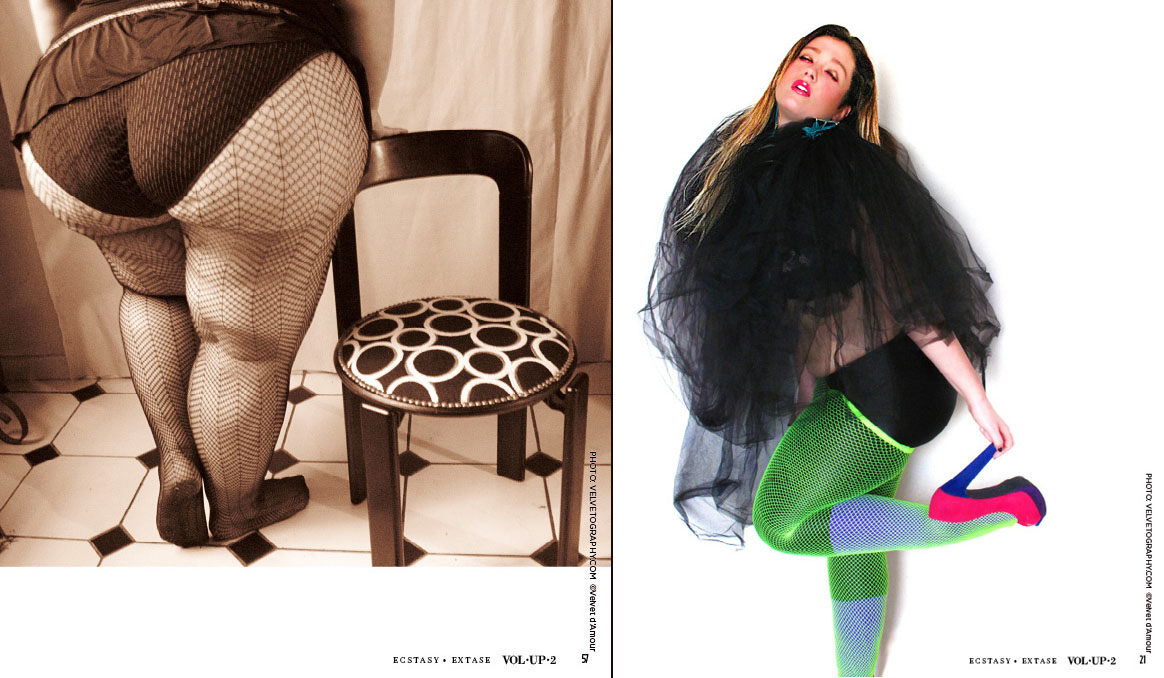
If you learn nothing else today, you will learn (if you didn't know already) how amazing open-work stockings look on fat girls.
Volup 2 is a new magazine from ex-pat American plus-sized model and photographer, Velvet d'Amour. As far as I can tell she had a hand in photographing and styling almost every shoot in all 300+ pages of Volup 2, which she describes as:
I really enjoyed seeing the eye of a fashion photographer brought to bear on fat bodies, and how fat bodies wear clothes, without the usual need to sculpt them with perspective into vague, largish constructions supporting acceptably unfat faces. Her camera is really looking at these plump--fat--thick--bodies. She really wants so know how they look in the clothes they're wearing. It's fun. I don't totally know how I feel about the naked black dude in one of the shoots, but in general I really loved this mag. Nice to see older women and a woman in a wheelchair, too. Often NSFW in delicious ways.
If you learn nothing else today, you will learn (if you didn't know already) how amazing open-work stockings look on fat girls.
Volup 2 is a new magazine from ex-pat American plus-sized model and photographer, Velvet d'Amour. As far as I can tell she had a hand in photographing and styling almost every shoot in all 300+ pages of Volup 2, which she describes as:
A bilingual English/French online quarterly magazine showcasing diverse beauty, with an emphasis on curvy women, and exploring the generosity of Mind, Body and Spirit.D'Amour became famous when she was a 2006 Gaultier runway model and her continuing interest in fashion shows. That is, Volup 2 is a fashion mag--sort of. Fashion, clothes, bodies, makeup, locales. Femmey femme.
I really enjoyed seeing the eye of a fashion photographer brought to bear on fat bodies, and how fat bodies wear clothes, without the usual need to sculpt them with perspective into vague, largish constructions supporting acceptably unfat faces. Her camera is really looking at these plump--fat--thick--bodies. She really wants so know how they look in the clothes they're wearing. It's fun. I don't totally know how I feel about the naked black dude in one of the shoots, but in general I really loved this mag. Nice to see older women and a woman in a wheelchair, too. Often NSFW in delicious ways.
Labels:
photo tuesday,
velvet d'amour,
volup 2
Stay Fatty and Carry On!
T-shirts for sale! White tees go to 5x; dark tees to 3x. Store at Zazzle to come shortly (white tees there go up to 6x).
Labels:
Stay Fat and Carry On
ahhhhh
What a lovely surprise, while reading a garden-variety health-related piece in a mainstream magazine (February 2012 issue of Martha Stewart Living), this one concerning "The Truth Behind 10 Cholesterol Myths," to come upon a fact that sounded uniquely size-positive for the context. Although really what was so refreshing about it was that it was just information. Not presented as part of any system of thinking about size, not there for any other reason except to sell magazines (basically):
One of the very most worrisome things about size prejudice in the health media is that people DON'T GET THE RIGHT INFORMATION. They are prepped to not get it, or see it, by bigotry. Critics of size acceptance say that fat people are just looking for reasons to "excuse" being fat, or make it okay (let's sidebar that argument for the moment), but seriously--what about the thin person with really high cholesterol who gets a sense it doesn't matter due to the way the issue is sold in the media? Or doesn't check it at all, because they think they don't have to--that only the fatties have heart problems?
We go through this over and over with heart disease in America--everyone's all baffled and surprised when (for instance) a thin, long-time runner like David Letterman needs heart surgery despite major hereditary risks. We're pretty sure we can diagnose disease from looking at people. But that denies the complexities--and complications--of the human body. Whatever size it is.
Information is good. Good job, MStew. Very refreshing!
One of the very most worrisome things about size prejudice in the health media is that people DON'T GET THE RIGHT INFORMATION. They are prepped to not get it, or see it, by bigotry. Critics of size acceptance say that fat people are just looking for reasons to "excuse" being fat, or make it okay (let's sidebar that argument for the moment), but seriously--what about the thin person with really high cholesterol who gets a sense it doesn't matter due to the way the issue is sold in the media? Or doesn't check it at all, because they think they don't have to--that only the fatties have heart problems?
We go through this over and over with heart disease in America--everyone's all baffled and surprised when (for instance) a thin, long-time runner like David Letterman needs heart surgery despite major hereditary risks. We're pretty sure we can diagnose disease from looking at people. But that denies the complexities--and complications--of the human body. Whatever size it is.
Information is good. Good job, MStew. Very refreshing!
Labels:
cholesterol,
martha stewart,
media
Saturday, March 10, 2012
These are double-sided, laminated bookmarks I made around the same time as the button, in the post below, I think (maybe 1999?). There was a template for them in my second 'zine and I still have a big pile of them. I used to slip them into diet books at the bookstore and under the flaps of boxes of diet products. Hee! Naughty. They are fun to carry with you when you are out and want to fight the power. Just a wee bit. With wee sliplets of revolution! I think I may start carrying these again.
Thursday, March 8, 2012
Wednesday, February 1, 2012
Stand Against Weight Bullying
I have been very happy the last couple weeks to donate my Photoshopping time to this project:
...which is one of the organized responses to the Strong4Life campaign in Georgia. It's a project that is trying to reduce rates of childhood obesity with "harsh" (their words) advertising showing chubby children in black and white photos staring sadly into the camera with fat-shaming slogans like: IT'S HARD TO BE A LITTLE GIRL WHEN YOU AREN'T.
That one breaks my heart. How dare they say little fat girls aren't little girls. It's hard not to be mad and heartsick when you see advertising that recreates visually the worst of what it's like to be treated as a fat kid and then tells the kid it's their fault. Basically the campaign is an endorsement of fat prejudice.
I don't know that they're trying to do this--I don't know that they even see that they're doing this (well, now they probably do). I am going to give them the benefit of the doubt at the moment for no other reason that contemplating the opposite makes me exhausted, and note that truly, yea verily, the road to hell is paved with good intentions, and that like many organizations like this--organizations that make heavy-handed mistakes like this--they are probably passionately interested in the health of children. The problem--the dead-end--is tying health to size, full-stop, and working backwards from there. Good health--bad health--health is much more complicated than that. And why is there no concern for thin children who have health problems that may stem from their different diets? And is there anything about this project that would make a fat kid want to run around outside?
It seems like so many conflicts that the people promoting this and the people aghast at it are quite close together, as well as far apart, like the ends of an unclosed circle. If people could set aside the blindness that comes from fat prejudice, there is common ground here. We all want healthy, active kids.
So, the "I STAND" Tumblr and photos (called "STANDards") are one response to all this. They're fun, they're real, they're diverse, they're happy, and they are positive and focused on health. People are smiling! I really like that.
If you'd like to do one yourself email Marilyn Wann at Marilyn@fatso.com with a photo and a short slogan that completes the phrase "I stand...".
Another response to Strong4Life is the fabulous Billboard Project run by Regan Chastain. The idea is to put up positive messages on billboards to counteract the message of Strong4Life in the Atlanta area. Fundraising for this project starts at midnight tonight--here's the link!
In the meantime, some more great STANDards (the first one is Debora Iyall of Romeo Void):
...which is one of the organized responses to the Strong4Life campaign in Georgia. It's a project that is trying to reduce rates of childhood obesity with "harsh" (their words) advertising showing chubby children in black and white photos staring sadly into the camera with fat-shaming slogans like: IT'S HARD TO BE A LITTLE GIRL WHEN YOU AREN'T.
That one breaks my heart. How dare they say little fat girls aren't little girls. It's hard not to be mad and heartsick when you see advertising that recreates visually the worst of what it's like to be treated as a fat kid and then tells the kid it's their fault. Basically the campaign is an endorsement of fat prejudice.
I don't know that they're trying to do this--I don't know that they even see that they're doing this (well, now they probably do). I am going to give them the benefit of the doubt at the moment for no other reason that contemplating the opposite makes me exhausted, and note that truly, yea verily, the road to hell is paved with good intentions, and that like many organizations like this--organizations that make heavy-handed mistakes like this--they are probably passionately interested in the health of children. The problem--the dead-end--is tying health to size, full-stop, and working backwards from there. Good health--bad health--health is much more complicated than that. And why is there no concern for thin children who have health problems that may stem from their different diets? And is there anything about this project that would make a fat kid want to run around outside?
It seems like so many conflicts that the people promoting this and the people aghast at it are quite close together, as well as far apart, like the ends of an unclosed circle. If people could set aside the blindness that comes from fat prejudice, there is common ground here. We all want healthy, active kids.
So, the "I STAND" Tumblr and photos (called "STANDards") are one response to all this. They're fun, they're real, they're diverse, they're happy, and they are positive and focused on health. People are smiling! I really like that.
If you'd like to do one yourself email Marilyn Wann at Marilyn@fatso.com with a photo and a short slogan that completes the phrase "I stand...".
Another response to Strong4Life is the fabulous Billboard Project run by Regan Chastain. The idea is to put up positive messages on billboards to counteract the message of Strong4Life in the Atlanta area. Fundraising for this project starts at midnight tonight--here's the link!
In the meantime, some more great STANDards (the first one is Debora Iyall of Romeo Void):
Labels:
Dances With Fat,
marilyn wann,
Regan Chastain,
Strong4Life
Tuesday, January 31, 2012
all evidence to the contrary
Yes, fat can be healthy. Thin can be unhealthy. So whenever we make assumptions about a person's lifestyle based on weight, we should know that our judgment is really based on aesthetics, not health. If we won't listen to the many fat acceptance experts who have been telling us this for years, maybe we'll listen to a "cute" thin girl whose diet is killing her.An extremely good point--the point about all this stuff, really--from a tight, well-written piece by Amanda Hess about media coverage of Stacey Irvine, a girl in England who's eaten nothing but chicken nuggets and fries from McDonald's for years and is now suffering anemia and other problems. Cultural bias is so strong that the assumption Irvine is fat persists even though all the articles show photos of her. She's thin.
People seem to be clucking in bemused shock at her. Does seriously nobody care about unhealthy thin children? This worries me as much as the way fat kids are treated.
Friday, January 27, 2012
hey Paula
![]() |
| photo accompanying People poll |
What's to say? She has diabetes. Kinda awful. The story, like all of these news stories with huge amounts of traction, represents a challenging test case of our feelings. In this country we really love issues when they are attached to one person, preferably in some intense form. With all the variables ratcheted up. That's how we like to shape our discussions of issues. We think we can solve them if we crack the dilemmas one person embodies. Except of course, they're not solvable that way--you don't "solve" issues looking at individual people.
Anyhow, I saw this today on People's home page (what, was I not going to click on it?):
It occurs to me that what is so wrong with this may not leap out at everybody, but the reason I'm finally blogging about this little chapter in the whole PD story is HELLO WE DON'T AND IN FACT SHOULD NOT HAVE ANY INPUT IN WHAT SHE OR ANYBODY ELSE EATS LAY OFF WHO CARES NONE OF OUR BEEZWAX.
She is a person engaged in the ugly business of money and celebrity, and that makes it hard to see where the boundaries are, and yes that Krispy Kreme burger she made on her show sure looks gluttonous, and yes it's all kinda sticky, but that question above shouldn't be asked. It scares the hell out of me in some ways to see it put as baldly as that.
When you click on the poll, these are the two options:
--which at first make the whole thing look better, but there is ultimately no difference between the two. Either way--she shouldn't eat hamburgers or she can enjoy the occasional burger--we're telling her what to do.
Plus--are we saying if she gorged in private then it'd be okay? (Since this is about appearances and setting examples.) Or if she starved herself? How will we be sure she is only occasionally enjoying a burger? Are we planning on photographing her every time she eats? Will we know by whether or not she is thinner? Are we getting her A1c numbers and fasting glucose levels?
Modern celebrity being what it is--we might see those numbers. She might show us these numbers. And she will from now on probably get photographed every time she eats in public. She may involve us in all this á la Kirstie Alley and Wynonna Judd and people like that--make us complicit via the media in her weight guilt or struggles or angst or do the opposite and dive into a chocolate trifle on TV (although I think Deen actually has some decent boundaries in amongst all this murkiness, weirdly). But you know what, we don't get to tell anybody what to eat. We just don't.
I think the issue in this case is a lot about seeing her eating. It's one thing to talk about it, but to actually see it seems to spark visceral reactions in people (and in People!). To me this reaction feels instinctively connected to the way fat people are often effaced and desired to be invisible in public and in the media. Because if a fat body is Wrong, then you're just kinda supposed to hide until it's Right. Kind of like--you go home and fix that, and then you can come back. You may be begrudgingly allowed out in the meantime, but if you're seen doing something to make it Wronger, especially eating--something that people are dead sure is making it more Wrong--then you are violating an unspoken contract with the world.
I know this sounds melodramatic, but think about it: If your body is wrong, and you caused it, how are you allowed to exist--to be seen, which is the same thing in the media--right now? In what way? Eating what? The only way you're 'allowed' to be fat with any approximation of autonomy is if you are shown to be trying to change it--or if you at least aren't seen doing things that everyone is quite sure make fat happen (like eating a hamburger). Then the criticism is held off just a little. At a fundamental cost, of course, because you must always make it clear first you don't like your body either. But if you don't do this...all bets are off. The world's going to go get the belt.
The other day somebody posted this comment by her sister on her Tumblr page: "I think people who don’t actively try to lose weight should be euthanized." People have posited that fat children should not be given food stamps, because "they've already had enough food." That's what I'm talking about. These horrible sentiments are nothing more than the usual thinking--all the much nicer, concern-trolly versions--taken to their logical ends.
Anyhow. I certainly won't solve anything by writing about her either, but I do wish people would back off.
As of right now, by the way, these are the results of the poll. I guess if one of them has to be 84%, might as well be #2.
Labels:
kirstie alley,
paula deen,
people magazine
Subscribe to:
Posts (Atom)