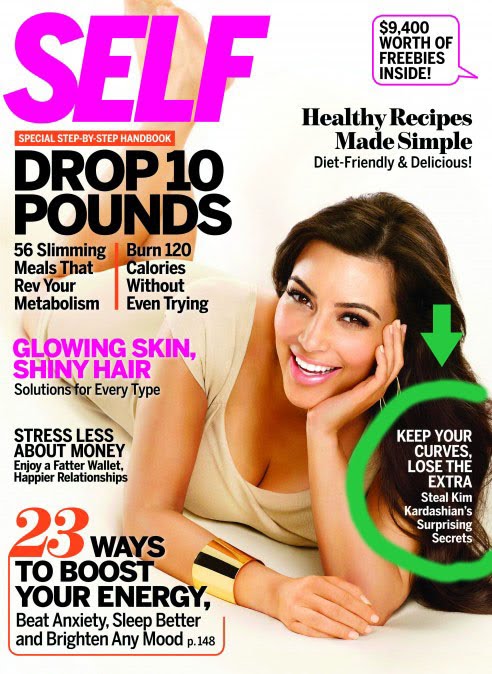
At the left: Variation #209,873 on making something completely out of one's control--body type--a fad, so as to spur impotent fanciful longing and money-spending, a reaching for an ideal that has likely SFA to do with what your own body looks like, however big it is or isn't. It is not possible, note, to move your body fat around like clay, to pad some bits ("keep your [socially-acceptable] curves") and lose the "extra." Not how the human body works.
When I was growing up it was all the same, just a different ideal: if you dieted and spent money and worked hard enough you could suddenly be a hipless preppy wonder. The ideal changes, the longing to change doesn't. "Spot-reducing exercises"...remember those? They were supposed to make the right things thin, leave the rest.
I hate when people push any look as the Real Whatever. The whole Real Women Have Curves thing, for instance, is such crap. Real women: have boobs, don't have boobs, have hips, don't have hips, are big, small, thin, fat, tall, short, blah, blah. Nobody needs the validation of "real"--any woman is a real woman. To use the word real is only, as people say, to suggest its opposite.
Showing posts with label liz soapboxes. Show all posts
Wednesday, March 23, 2011
Tuesday, February 22, 2011
Knock it off, all of you.
One ass-backwards benefit of fat hate is that it can allow you to see straight into the pulsing heart of human stupidity.
People simultaneously talk more about and are more dumb about body size than almost any other topic I can think of, which means that when they open their mouths you can get a look right into the core of people's most insecure, lazy, hateful, myopic, hurt, catchpenny thinking. Such stupidity is not helpful, and although it's all horribly discouraging, it does give you a 1/8 second head start on calling bullshit sometimes because it comes with glowing red signs.
I am aware that this is just a way of saying I Know Better--but still; there is really nothing quite like how dumb people are around body image, precisely because we are all--all of us--so persecuted by it. We're all victims and bullies, which pretty much guarantees the Duh.
On Rush Limbaugh's show yesterday he took Michelle Obama to task for not having the body to back up her policies (!):
But it's terribly angering that he would criticize her for her size--whatever it was--and not only that, decide the the point of comparison for the First Lady should be the Sports Illustrated swimsuit cover. The conflation of ideals and pressures and sexual thinking there is quite appalling, and at base seems to be extremely hateful, because, note, the woman is thin; the only reason he would seem to be able to--or want too--latch onto this as a thing is because you can actually see Obama's body. She doesn't hide it. He is criticizing the fact that she has one, and, perhaps, that it is a body type associated with African-American women. That's unforgiveable.
But you know what--I hated the title of Al Franken's book (Rush Limbaugh Is a Big, Fat Idiot) too. I did. I don't enjoy Limbaugh being body-shamed. He is a florid-faced fat man, and an easy object of sputtering derision. It would be extremely easy to say to him, and I'm sure people are, regarding Obama: who are you to talk? You are actually fat yourself, how dare you? But that would be wrong too, and dig the hole deeper. Nobody should do that. It benefits nobody. It bolsters more stereotypes. It foments more hatred towards self and others.
Which--it must be said--is what Limbaugh is about, consciously encouraging hate, which is spectacularly exhausting as well as mean. It would be lovely to not feed the troll here, to just let him, and people like Andrew Breitbart, sputter away in misguided, misogynous, pain-fueled hate without any traction.
Because they're being hateful, but they're also just being stupid. So is Sarah Palin, in her reactionary anti-Michelle Obama food-related stunts. So--unfortunately--is Michelle Obama at times in her efforts fighting childhood obesity. All of them are focusing in various ways on body size, not health. The focus is on fat people and what is assumed that fat people do to be fat as the cause of our problems, rather than a symptom of the world we live in.
Don't they know nobody wins here? Nobody is immune? A 400-pound woman has stuff thrown at her on the street, earns less money, won't fly for fear of ridicule. But a tall, thin woman in a position of power is also torn down for not looking like an SI model. Rush Limbaugh takes another turn on the spit of fat-hating and believes even more in the worth of his vitriol. A fat little kid who loves running around is told she's doing something wrong and starts to hate her body and get fatter. Nobody wins.
People simultaneously talk more about and are more dumb about body size than almost any other topic I can think of, which means that when they open their mouths you can get a look right into the core of people's most insecure, lazy, hateful, myopic, hurt, catchpenny thinking. Such stupidity is not helpful, and although it's all horribly discouraging, it does give you a 1/8 second head start on calling bullshit sometimes because it comes with glowing red signs.
I am aware that this is just a way of saying I Know Better--but still; there is really nothing quite like how dumb people are around body image, precisely because we are all--all of us--so persecuted by it. We're all victims and bullies, which pretty much guarantees the Duh.
On Rush Limbaugh's show yesterday he took Michelle Obama to task for not having the body to back up her policies (!):
It is appalling (and stupid) that he would criticize individual food choices without context like that--not to mention an extremely harsh (and stupid) way of viewing the world, where every single thing you eat is either Wrong or Right and somebody's keeping track--not to mention a very self-defeating (and stupid!) way to go after somebody politically, since we none of us would pass that test--not to mention extremely revealing of his own struggles with public criticism of his size, that he can whip out data about fat grams so easily there.The problem is--and dare I say this--it doesn't look like Michelle Obama follows her own nutritionary, dietary advice. And then we hear that she's out eating ribs at 1,500 calories a serving with 141 grams of fat per serving, yeah it does--what do you mean, what do I mean?
What is it--no, I'm trying to say that our First Lady does not project the image of women that you might see on the cover of the Sports Illustrated swimsuit issue, or of a woman Alex Rodriguez might date every six months [whom A-Rod is dating right now: click here] or what have you. I mean, women are under constant pressure to look lithe, and Michelle My Belle is out there saying if you eat the roots and tree bark and the berries and all this cardboard stuff you will live longer, be healthier and you won't be obese. Okay, fine, show us.
But it's terribly angering that he would criticize her for her size--whatever it was--and not only that, decide the the point of comparison for the First Lady should be the Sports Illustrated swimsuit cover. The conflation of ideals and pressures and sexual thinking there is quite appalling, and at base seems to be extremely hateful, because, note, the woman is thin; the only reason he would seem to be able to--or want too--latch onto this as a thing is because you can actually see Obama's body. She doesn't hide it. He is criticizing the fact that she has one, and, perhaps, that it is a body type associated with African-American women. That's unforgiveable.
But you know what--I hated the title of Al Franken's book (Rush Limbaugh Is a Big, Fat Idiot) too. I did. I don't enjoy Limbaugh being body-shamed. He is a florid-faced fat man, and an easy object of sputtering derision. It would be extremely easy to say to him, and I'm sure people are, regarding Obama: who are you to talk? You are actually fat yourself, how dare you? But that would be wrong too, and dig the hole deeper. Nobody should do that. It benefits nobody. It bolsters more stereotypes. It foments more hatred towards self and others.
Which--it must be said--is what Limbaugh is about, consciously encouraging hate, which is spectacularly exhausting as well as mean. It would be lovely to not feed the troll here, to just let him, and people like Andrew Breitbart, sputter away in misguided, misogynous, pain-fueled hate without any traction.
Because they're being hateful, but they're also just being stupid. So is Sarah Palin, in her reactionary anti-Michelle Obama food-related stunts. So--unfortunately--is Michelle Obama at times in her efforts fighting childhood obesity. All of them are focusing in various ways on body size, not health. The focus is on fat people and what is assumed that fat people do to be fat as the cause of our problems, rather than a symptom of the world we live in.
Don't they know nobody wins here? Nobody is immune? A 400-pound woman has stuff thrown at her on the street, earns less money, won't fly for fear of ridicule. But a tall, thin woman in a position of power is also torn down for not looking like an SI model. Rush Limbaugh takes another turn on the spit of fat-hating and believes even more in the worth of his vitriol. A fat little kid who loves running around is told she's doing something wrong and starts to hate her body and get fatter. Nobody wins.
Labels:
liz soapboxes,
michelle obama,
rush limbaugh
Saturday, February 5, 2011
diets and the damage done
My high school years parked two really bad songs in my brain for the rest of my life--at least two, but these are the worst.
One was from German class. I desperately wanted to take French when I started high school, but French was full, and thus were the next eight years of my life and two exchange programs decided. In eleventh grade my German teacher had us learn "Das Lied der Deutschen" as part of our curriculum. At that point the third stanza was the national anthem of West Germany, but for some reason we learned all the stanzas, including the first. Not a good stanza. Not only did we sing the song, I accompanied us on the piano, which guaranteed that the tenaciously catchy tune lives on in my babbling singing brain and surfaces occasionally at bad times. Any time is horrible to start singing "Deutschland, Deutschland, über alles," really. I try not to let that happen, but wish I could just unlearn it.
The other song came from a diet center I belonged to. I don't remember the name of the center now, or that much about it at all in some ways. The experience feels like a dream, comes back to me in whole flashes of feeling for brief, thick moments. The place was a relic of the 1970s, maybe, or the 1960s, named after a woman, I think. I know that I was a member there sometime before my two tours of duty in Weight Watchers, which would put this in the early 1980s, when I was around 16.
The center was in a mall. I remember a pink and purple interior with no windows and low ceilings. It was flowery, maybe, or paisley. I vaguely remember vibrating belt exercisers--those things hurt--and other old-fashioned equipment. I thought the place was sort of old-fashioned, and felt shame that my fatness would bring me into contact--as did clothes-buying, for instance, in that era of double-knits--with the world of middle-aged women; not only that, that's the world I was eligible for. It was disorienting and shaming.
One of the only things I recall at all vividly about the place is the song we had to sing while doing a little calisthenics routine that involved toe-touching and other movements on the floor:
Who hit Sally in the belly with the meatball?We did our large, jerky gestures on the downbeats, so that the whole thing had a very singsong, drums-on-a-boat quality:
Oh dear! I fear! I've over-developed my rear!
WHO hit SAL-ly in the BEL-ly with the MEAT-ball?To this day that song appears unbidden in my brain whenever it feels like it, or perhaps when a piece of prose with the right meter triggers the rhythm. I wish I could excise the song and let something else take its place in my brainpan, but I think it's stuck.
Oh DEAR! I FEAR! I've OV-er-de-VEL-oped-my-REAR!
I wish I could excise the whole experience. I wish I could save me and all the housewives from that windowless place; blast in, push all of us through the door like a member of the SWAT team before all that bullshit explodes and takes us with it.
It's hard to know what to wish for in healing from diet experiences, because they are so far-reaching in every direction, so tenacious, so complicated, so woven into every aspect of your life. The wound it would leave if you yanked it out whole would not heal. It would be easier to just start over at the beginning and hope to crowd it out with acceptance. But you can't.
One day when my mom dropped me off at the diet center--she and I had argued about how much weight I had to lose; I said, wildly, "Thirty pounds!", hoping against hope she would say, "No, you don't really need to lose any," and was heartsick when she countered with, "No, fifteen"--I discovered when I went inside there was a potluck. I could hardly believe they dared bring explosive material such as food--lots of it, not all diet fare--in this place, but I was very excited. Stirred-up. I remember somebody urging me to eat. That's all I did for my hour, although I pretending to be doing other things, as if it wasn't important. I scarfed food I didn't normally get, like Oreos, at one point pushing them in my face while hiding in the dressing room. How could anybody just let cookies sit there? Have just a few? Have none? I lied to the people at the diet center about what I was doing, sure everyone was watching me pretending not to care while all the time I watched the food like prey. I lied to my mother in the car afterward about my hour "exercising," and felt dirty and ashamed.
And stirred up. I don't know that anything could have saved me from impetus of disordered eating at that point of my life. Experiences such as the diet center were just one push in the forces that set the pendulum swinging so hard I didn't know where the point of equilibrium was for years. The forces that keeps us off-balance about food are huge, period. When the pendulum isn't swinging the earth itself under our feet is. It is worth finding the position of repose, though, to come back to, over and over. It's possible to find it, to heal. You may have to let the whole world tilt without you, though.
Thursday, January 13, 2011
the need for matched sets
In his review for The Dilemma in the New York Times, A.O. Scott writes:
We don't know what to do--we think we don't--with mismatched couples, when the violated criteria is that of some presumably agreed-upon Hotness. How can it happen? What is the hot one getting out of it (seems to be the idea)--when it's not an obvious question of material gain? If body size is something we make and earn with every action we take, how can somebody who's done the "right" things "deserve" somebody whose done the "wrong"?
Sometimes you just need scare quotes.
Despite our confusion, we see a lot of examples in modern media of "regular guy with the hot wife" phenom that offends so many's sensibilities, such as The Dilemma:
They can offend me too, but not because it violates some sense of symmetry that I think is part of the natural order.
It certainly bothers me that it's considered so far out of the realm of possibility to show a large woman who is loved, partnered, perhaps even has a child. (Who knew the phenom of a fat mom would be so rare? I almost miss that stereotype). It bothers me that media execs are still so ready to build shows and movies around men who don't fit extremely stringent criteria for conventionally attractive, when the women must--they are pinned down in a very, very narrow range of acceptable. There is a reason these couples do look sort of clunky sometimes.
But what bothers me the most is that the "mismatching" is created because media folk get boxed in by beauty ideals, not from any real belief that that people can like qualities different than themselves in their partners. People really do like different things sometimes (heterosexuality being a good example). They're called preferences. Crazy. There really are smaller women who like bigger men.
There are tall people who like short people, short people who like tall people, fat people who like skinny people, skinny people who like fat people, black people who like white people, white people who like black people, older people who like younger people, younger people like older people...for however much time you have to match things up and however many columns A and B you can think of (or more), there are people out there mixing it up in low- to high-contrast ways. Nor does the fact that somebody likes something different necessarily make it a fetish, either. That seems to be the category that preferences get dumped in when they are too obvious to be borne or involve preferences of which people disapprove. Such as a fat partner. Some people actually prefer them. Just because they do.
The chunkier guy/thinner woman idea, while not approved (see above), does have some traction from just sheer force, maybe, or from a lurking suspicion that the average woman might indeed like a hug from a solid, money-earning guy at the end of the day (or however they might rationalize a physical preference). But the fat woman/skinny guy thing is rarely to be countenanced. It's hard to imagine a skinny Mike/fat Molly sitcom, when the idea of a skinny man preferring a fat woman still seems to be associated with a kind of emasculated delusion about what he's getting into. Two fat people, well--they just don't know any better. One fat, one thin...why are they putting up with it?
Unconventional female looks being a much bigger violation of social order than male ones, I'm not sure the media even knows how to approach it, given that it runs on steam-powered looksism most of the time. Look at all the vibrations that emanated from the marriage of Elizabeth and John Edwards; after her death people were still trying to make sense of what they felt had no real way to understand. Or of what needed examination to comprehend. Maybe he just thought she was attractive, you know? She was.
One of the things you hopefully learn as you get older is that you can't even know all the ways love--or lust--looks at an individual level, which is to say a million different ways, even without strong preferences in the fray, which mix it up a million times more. Surely we don't need one more astonished celebrity-rag article about men cheating on their "perfect" wives to prove this. If people really are free to love who they want, and do, let's show it. It we're still not really free to do so--all the more reason to show it and get people used to it. You like what you like. Even when it doesn't look exactly like you.
Mr. Vaughn and Mr. James play bulky best buds romantically paired (because they’re Not Gay) with pretty, fine-boned women. Mr. James is Nick, married to Geneva (Winona Ryder), and Mr. Vaughn is Ronny, gathering the nerve and the money to propose to his longtime girlfriend, Beth (Jennifer Connelly). To ask if Mr. Vaughn and Ms. Connelly have any chemistry is to invoke the wrong science; extreme disparities of size and shape suggest, instead, a fascinating problem of zoology, as if a whippet had decided to cohabit with a yak.A whippet and a yak! Goddamn. And here I thought they were Homo sapiens.
We don't know what to do--we think we don't--with mismatched couples, when the violated criteria is that of some presumably agreed-upon Hotness. How can it happen? What is the hot one getting out of it (seems to be the idea)--when it's not an obvious question of material gain? If body size is something we make and earn with every action we take, how can somebody who's done the "right" things "deserve" somebody whose done the "wrong"?
Sometimes you just need scare quotes.
Despite our confusion, we see a lot of examples in modern media of "regular guy with the hot wife" phenom that offends so many's sensibilities, such as The Dilemma:
They can offend me too, but not because it violates some sense of symmetry that I think is part of the natural order.
It certainly bothers me that it's considered so far out of the realm of possibility to show a large woman who is loved, partnered, perhaps even has a child. (Who knew the phenom of a fat mom would be so rare? I almost miss that stereotype). It bothers me that media execs are still so ready to build shows and movies around men who don't fit extremely stringent criteria for conventionally attractive, when the women must--they are pinned down in a very, very narrow range of acceptable. There is a reason these couples do look sort of clunky sometimes.
But what bothers me the most is that the "mismatching" is created because media folk get boxed in by beauty ideals, not from any real belief that that people can like qualities different than themselves in their partners. People really do like different things sometimes (heterosexuality being a good example). They're called preferences. Crazy. There really are smaller women who like bigger men.
There are tall people who like short people, short people who like tall people, fat people who like skinny people, skinny people who like fat people, black people who like white people, white people who like black people, older people who like younger people, younger people like older people...for however much time you have to match things up and however many columns A and B you can think of (or more), there are people out there mixing it up in low- to high-contrast ways. Nor does the fact that somebody likes something different necessarily make it a fetish, either. That seems to be the category that preferences get dumped in when they are too obvious to be borne or involve preferences of which people disapprove. Such as a fat partner. Some people actually prefer them. Just because they do.
The chunkier guy/thinner woman idea, while not approved (see above), does have some traction from just sheer force, maybe, or from a lurking suspicion that the average woman might indeed like a hug from a solid, money-earning guy at the end of the day (or however they might rationalize a physical preference). But the fat woman/skinny guy thing is rarely to be countenanced. It's hard to imagine a skinny Mike/fat Molly sitcom, when the idea of a skinny man preferring a fat woman still seems to be associated with a kind of emasculated delusion about what he's getting into. Two fat people, well--they just don't know any better. One fat, one thin...why are they putting up with it?
Unconventional female looks being a much bigger violation of social order than male ones, I'm not sure the media even knows how to approach it, given that it runs on steam-powered looksism most of the time. Look at all the vibrations that emanated from the marriage of Elizabeth and John Edwards; after her death people were still trying to make sense of what they felt had no real way to understand. Or of what needed examination to comprehend. Maybe he just thought she was attractive, you know? She was.
One of the things you hopefully learn as you get older is that you can't even know all the ways love--or lust--looks at an individual level, which is to say a million different ways, even without strong preferences in the fray, which mix it up a million times more. Surely we don't need one more astonished celebrity-rag article about men cheating on their "perfect" wives to prove this. If people really are free to love who they want, and do, let's show it. It we're still not really free to do so--all the more reason to show it and get people used to it. You like what you like. Even when it doesn't look exactly like you.
Labels:
liz soapboxes,
New York Times,
the dilemma
Tuesday, September 7, 2010
How to Serve Up a Wire Story (or: Meat Keeps the Heat)
Watching health-related wire stories surface, in all their repackaged, stock photo-ed, frosted with crazy headlines glory, is always interesting.
This time the news is a study that showed fat men are able to maintain erections longer during intercourse than thin men; an average of 7.3 minutes versus 1.8 minutes, due to increased levels of the hormone estradiol.
Pick a photo: (headless) fat man fondling own belly; fat man lying in bed, fat man eating (the fuck?); (headless) fat man with belly fondled by other; or thin men in bed with women, all heads attached (??).

Pick a headline:
Fat Men Enjoy Longer Lasting Sex
Chubby Chaps 'Better in Bed'
Fat Men Capable of Making Love for Longer Duration, Claims Study
Bulky Lovers Make Better Love--Study
Women Should Look to Larger Lovers for a Bit of Nookie
(That last one is from a site that claims to be the "leader in extramarital dating since 1995"...not linking it.)
Decide how to convey the news (while, note, admitting naught but heterosexuality and assuming that female sexual satisfaction revolves, planet-like, around only The Unit). Posit a norm, anticipate our surprise at the news, shape data to the most confusing black and white, draw conclusions about what we're supposed to "do," and let it stand until the next study comes along to be misinterpreted:
Blah blah. Misinterpreting study results of any kind at all is a revered art, but the inability to let information stand on its own reaches high pitch around fat + health + sex.
This time the news is a study that showed fat men are able to maintain erections longer during intercourse than thin men; an average of 7.3 minutes versus 1.8 minutes, due to increased levels of the hormone estradiol.
Pick a photo: (headless) fat man fondling own belly; fat man lying in bed, fat man eating (the fuck?); (headless) fat man with belly fondled by other; or thin men in bed with women, all heads attached (??).

Pick a headline:
Fat Men Enjoy Longer Lasting Sex
Chubby Chaps 'Better in Bed'
Fat Men Capable of Making Love for Longer Duration, Claims Study
Bulky Lovers Make Better Love--Study
Women Should Look to Larger Lovers for a Bit of Nookie
(That last one is from a site that claims to be the "leader in extramarital dating since 1995"...not linking it.)
Decide how to convey the news (while, note, admitting naught but heterosexuality and assuming that female sexual satisfaction revolves, planet-like, around only The Unit). Posit a norm, anticipate our surprise at the news, shape data to the most confusing black and white, draw conclusions about what we're supposed to "do," and let it stand until the next study comes along to be misinterpreted:
"It may come as a surprise to many women, but chubby chaps can actually make love for longer, says a new study. . . the lardy lovers' secret lies in their spare tyre and the other rolls of fat, which affect the balance of their hormones."(Okay--most--although not all--of these news sources aren't particularly reputable, and this is all stupid easy shootin, but all the uninformed interpretation is scarier, yet much the same, as stories spread across more solid news sources. Such as the recent widespread wire story about people "not knowing" they are fat, using BMI as the determiner, but not including even widely accepted criticisms of this very imperfect measuring tool. For that we get fear-bating headlines like: Fat and Unaware; Americans Blind to the Obesity Epidemic; Many Fat People Don't Realize They Are Fat; Obese Don't See Themselves as Obese.)
"In a new and surprising revelation, fat men last longer in bed. Women will certainly surprised by this new scientific study which found that fat men could be best during sex."
"Women may swoon over six pack gym jocks, but disbelievingly they might opt for 'fatter men' than fitter ones when it comes to fulfilling the act in bed, claims a new study . . . The fatty men may be heaving a sigh of relief, but the fitter ones are not ready to accept the research."
Blah blah. Misinterpreting study results of any kind at all is a revered art, but the inability to let information stand on its own reaches high pitch around fat + health + sex.
Friday, July 30, 2010
The Public Pubic
What we expect of women's pussies--in public--is tough.
In the last year at least three products were launched to prevent camel toe. Last month it was a brand of panties called Camelflage; before that it was the Cuchini and Camel Ammo, inserts for women to place in
their underwear. Note the similar before/afters for the products: the images on the left side, with (something of) the shape of the vulva showing, i.e., camel toe, are "wrong." The images on the right are "correct"--corrected.
No way around it: there is an increasingly demanding beauty ideal for this most private part of a woman's anatomy these days. A public standard, for the increasingly public parts of our parts. We dare our pubic area to show--make it harder and harder not to show--yet penalize women more when it does. The ideal denies the (endless) reality of the female body, and pushes fat female bodies into a kind of sexual exile.
Our bodies are certainly more exposed in both clothing styles and level of casualness, and clothing is often thinner, clingier, and made from fabric without much tailoring, which can add the bulk and protection of seams. That doesn't mean fifteen or fifty years ago women's bodies were completely unavailable to the public eye, but the pubic area is suddenly there to be seen, much more than it used to be. And under tighter scrutiny--which amounts to the same thing. Nowadays women's pubic area is to be:
very flat in all directions; no hint of the pudendal cleft; no roundness, or very little, where the lines of a woman's legs and her pubic area meet; defined by lines that create a sharp, clear V that comes to a point. No hint of depth, no valleys, no mounding, basically. A sheer front of abdomen that ends in the pubic area without notable emphasis.
The ideal seems connected to things such as body size, but also to the wholesale flip in less than a generation to a baseline standard of little or no pubic hair. Pubic hair doesn't just provide physical protection, as it's designed to do, it provides visual protection. It can create its own visible shape but simultaneously prevent further scrutiny. Now, though, all the hair has to go--or at least be trimmed enough so that there is no hint of mass visible from the
outside, which makes the talk in my generation about managing the bikini line seem hopelessly outdated. American Apparel ads would be an obvious, aggressive example of the no-hair look, and are a worthwhile (if easy) target to comment on in all this mess, like Camelflage, but I don't think they should be treated with any surprise or as the worst example of our obsessions.
Because there are fierce standards at work here, even with a lot of seemingly modest clothing. We constantly trade in pussy-related beauty ideals at a high pitch whether we admit it or not. Regular low-rise jeans (not even skinny jeans), with their center seam, demand a very particular look. Bikinis do the same.
Yoga pants are another a good example; they are really harsh and unforgiving (strange, in such a comfy piece of clothing). They have to hang from your hips and cling nowhere else but your butt. There can't be anything there--protruding, sticking out--for them to look right.
That's the deal: the Absence of Things is actually the Thing here. No lumps, no bits, no swelling. Nothing visible--at the same time that very much more of the body itself is visible, so that people end up wearing their insides on their outside, practically. A naked vulnerability becomes the armor, the defense, proof of something. Our clothing isn't protecting us; our bodies are. You show what you don't have to prove that what lies hidden is worth seeing.
We show--expect to see--more and more of everything on the female body around the genitals, but there is allowed to be less and less 'evidence' of its existence or aspects of the body connected to it (pubic hair, belly fat, the pubic mound). What we define as our genitals--that which still remains private, until some line is crossed--is pushed into a tinier and tinier bit of real estate.
We're obsessed with things like camel toe--the Cuchini website runs a blog called Camel Toe Cops; there are sites all over that track camel toe sightings--but ultimately camel toe is in kind
of the same category as THO or VPL: phenoms that (hetero-shorthanding here) women think are embarrassing and men think are titillating. What's really significant is the scrutiny. A lot of camel toe photos are often nothing more than evidence that women have bodies that are not very clothed. Or maybe they are just evidence that women have bodies, period, such as this editorialized image of Oprah. No camel toe, just a body that must point more strongly in people's minds to the pubic area it surrounds with its curves.
Which leads to the fact that all this gets much worse, really fast, in the world of the fat body. If we are ruthlessly scanning thin bodies and finding things that don't exist, what happens to the fat ones, where we don't really know how to read bodies at all?
If that which is allowably, publicly "pubic" is just a constantly shrinking 2-D triangle, what about bodies that may actually have fat there? Or a bigger, more delineated mons? Or fat in the abdomen above it? Or all the many possible
deviations from the ideal? What about very large bodies? How do we read the "public" sexuality of that part of the fat female body? And why do we think we should? Fat bodies--bad clothing choices apart--can't hide, but what do we think we see anyhow?
It turns out we think we can see a lot, because here there are not just camel toes to be spotted, but FUPA (Fat Upper Pelvic Area--check out the 150 definitions at Urban Dictionary), gunts (gut + cunt = fat that droops over the pubic area), BIF (Butt in Front) or front butt, and moose knuckles. Any part of the lower abdomen that might stick out has a name. There are "FUPA"- and "gunt"-captioned LOLphotos of large women forwarded in emails and Facebook groups with names like "Fat legs camel toe, make a man go, HELL NO!" and "Saving The Planet From Fat Girls In Leggings." Throw "front butts" in YouTube and see what you get.
This terminology has some glaring similarities, in addition to being mean. One is that it is terrifically vague about fat female anatomy, which varies tremendously in this area, but regardless--the terms are confused. It's tummy--it's sexy parts--who knows.
There is a much-forwarded image of a woman with a large hanging belly that is sometimes labled "FUPA" and sometimes "gunt," when it's clear it is a belly, complete with belly button.
The other thing that really stands out is how sexual all the language can be--even when the parts aren't, particularly. A fat woman wearing a pair of pants that evidences a fat lower belly suddenly has a "gunt," is suddenly showing part of her sexual anatomy by being fat, when she may or may not be "showing" (as in camel toe)
anything at all. Apparently anything south of the navel on fat people is genitalia. Or butt. Fat in the lower abdomen can sometimes simultaneously be read as sexlessness (for both genders; there are FUPA photos of men and the term moose knuckle is misapplied--if you can say this about hateful language such as this--to very large women as well as fat men), but ultimately it's about sex.
And fat women bear the brunt of this slang. Just as all the attention to camel toe may not be based on what we think we see but more on how we read women's bodies, "FUPA" and "gunt" may be about nothing more than whether or not somebody tucks their shirt in. Or is too fat for people to not read their pubic area while clothed. A belly isn't a vulva, but finding a way to call it that--when as far as I know everyone's belly is connected to their pubic mound
which is connected to the rest of their vulva--seems to say: look. It's spilling out, we can see it all. You are showing your most private parts--even though you are clothed. We know all of your body and don't like/want it.
These terms are a way to call out sexual humiliation, ultimately, for bodies that can't play the tiny pubic real estate game. This language, to paraphrase Eric Rohmer, denies fat women the mystery we should grant them, that we should grant everybody.
This never-ending, detailed, yet seriously stupid public examination of women's bodies is brutal, and it is especially rough on everything from the belly down. Every bit has a name, every
bit or lack of has sexual and cultural value, every fold in a shirt could be a baby bump, every pair of high-waisted pants signifies weight gain and FUPA and sloppy sexuality, every part of
female genitalia is "vag." Mom jeans and pubic hair evidence silly and shameful aspects of womanhood, and any hint of a large labia can't be countenanced. It can't be an accident that everything below the navel is the part of the body women, fat or thin, agonize about the most.
In the last year at least three products were launched to prevent camel toe. Last month it was a brand of panties called Camelflage; before that it was the Cuchini and Camel Ammo, inserts for women to place in
their underwear. Note the similar before/afters for the products: the images on the left side, with (something of) the shape of the vulva showing, i.e., camel toe, are "wrong." The images on the right are "correct"--corrected.
No way around it: there is an increasingly demanding beauty ideal for this most private part of a woman's anatomy these days. A public standard, for the increasingly public parts of our parts. We dare our pubic area to show--make it harder and harder not to show--yet penalize women more when it does. The ideal denies the (endless) reality of the female body, and pushes fat female bodies into a kind of sexual exile.
Our bodies are certainly more exposed in both clothing styles and level of casualness, and clothing is often thinner, clingier, and made from fabric without much tailoring, which can add the bulk and protection of seams. That doesn't mean fifteen or fifty years ago women's bodies were completely unavailable to the public eye, but the pubic area is suddenly there to be seen, much more than it used to be. And under tighter scrutiny--which amounts to the same thing. Nowadays women's pubic area is to be:
very flat in all directions; no hint of the pudendal cleft; no roundness, or very little, where the lines of a woman's legs and her pubic area meet; defined by lines that create a sharp, clear V that comes to a point. No hint of depth, no valleys, no mounding, basically. A sheer front of abdomen that ends in the pubic area without notable emphasis.
The ideal seems connected to things such as body size, but also to the wholesale flip in less than a generation to a baseline standard of little or no pubic hair. Pubic hair doesn't just provide physical protection, as it's designed to do, it provides visual protection. It can create its own visible shape but simultaneously prevent further scrutiny. Now, though, all the hair has to go--or at least be trimmed enough so that there is no hint of mass visible from the
outside, which makes the talk in my generation about managing the bikini line seem hopelessly outdated. American Apparel ads would be an obvious, aggressive example of the no-hair look, and are a worthwhile (if easy) target to comment on in all this mess, like Camelflage, but I don't think they should be treated with any surprise or as the worst example of our obsessions.
Because there are fierce standards at work here, even with a lot of seemingly modest clothing. We constantly trade in pussy-related beauty ideals at a high pitch whether we admit it or not. Regular low-rise jeans (not even skinny jeans), with their center seam, demand a very particular look. Bikinis do the same.
Yoga pants are another a good example; they are really harsh and unforgiving (strange, in such a comfy piece of clothing). They have to hang from your hips and cling nowhere else but your butt. There can't be anything there--protruding, sticking out--for them to look right.
That's the deal: the Absence of Things is actually the Thing here. No lumps, no bits, no swelling. Nothing visible--at the same time that very much more of the body itself is visible, so that people end up wearing their insides on their outside, practically. A naked vulnerability becomes the armor, the defense, proof of something. Our clothing isn't protecting us; our bodies are. You show what you don't have to prove that what lies hidden is worth seeing.We show--expect to see--more and more of everything on the female body around the genitals, but there is allowed to be less and less 'evidence' of its existence or aspects of the body connected to it (pubic hair, belly fat, the pubic mound). What we define as our genitals--that which still remains private, until some line is crossed--is pushed into a tinier and tinier bit of real estate.
We're obsessed with things like camel toe--the Cuchini website runs a blog called Camel Toe Cops; there are sites all over that track camel toe sightings--but ultimately camel toe is in kind
of the same category as THO or VPL: phenoms that (hetero-shorthanding here) women think are embarrassing and men think are titillating. What's really significant is the scrutiny. A lot of camel toe photos are often nothing more than evidence that women have bodies that are not very clothed. Or maybe they are just evidence that women have bodies, period, such as this editorialized image of Oprah. No camel toe, just a body that must point more strongly in people's minds to the pubic area it surrounds with its curves.Which leads to the fact that all this gets much worse, really fast, in the world of the fat body. If we are ruthlessly scanning thin bodies and finding things that don't exist, what happens to the fat ones, where we don't really know how to read bodies at all?
If that which is allowably, publicly "pubic" is just a constantly shrinking 2-D triangle, what about bodies that may actually have fat there? Or a bigger, more delineated mons? Or fat in the abdomen above it? Or all the many possible
deviations from the ideal? What about very large bodies? How do we read the "public" sexuality of that part of the fat female body? And why do we think we should? Fat bodies--bad clothing choices apart--can't hide, but what do we think we see anyhow?
It turns out we think we can see a lot, because here there are not just camel toes to be spotted, but FUPA (Fat Upper Pelvic Area--check out the 150 definitions at Urban Dictionary), gunts (gut + cunt = fat that droops over the pubic area), BIF (Butt in Front) or front butt, and moose knuckles. Any part of the lower abdomen that might stick out has a name. There are "FUPA"- and "gunt"-captioned LOLphotos of large women forwarded in emails and Facebook groups with names like "Fat legs camel toe, make a man go, HELL NO!" and "Saving The Planet From Fat Girls In Leggings." Throw "front butts" in YouTube and see what you get.
This terminology has some glaring similarities, in addition to being mean. One is that it is terrifically vague about fat female anatomy, which varies tremendously in this area, but regardless--the terms are confused. It's tummy--it's sexy parts--who knows.
There is a much-forwarded image of a woman with a large hanging belly that is sometimes labled "FUPA" and sometimes "gunt," when it's clear it is a belly, complete with belly button.The other thing that really stands out is how sexual all the language can be--even when the parts aren't, particularly. A fat woman wearing a pair of pants that evidences a fat lower belly suddenly has a "gunt," is suddenly showing part of her sexual anatomy by being fat, when she may or may not be "showing" (as in camel toe)
anything at all. Apparently anything south of the navel on fat people is genitalia. Or butt. Fat in the lower abdomen can sometimes simultaneously be read as sexlessness (for both genders; there are FUPA photos of men and the term moose knuckle is misapplied--if you can say this about hateful language such as this--to very large women as well as fat men), but ultimately it's about sex.
And fat women bear the brunt of this slang. Just as all the attention to camel toe may not be based on what we think we see but more on how we read women's bodies, "FUPA" and "gunt" may be about nothing more than whether or not somebody tucks their shirt in. Or is too fat for people to not read their pubic area while clothed. A belly isn't a vulva, but finding a way to call it that--when as far as I know everyone's belly is connected to their pubic mound
which is connected to the rest of their vulva--seems to say: look. It's spilling out, we can see it all. You are showing your most private parts--even though you are clothed. We know all of your body and don't like/want it.These terms are a way to call out sexual humiliation, ultimately, for bodies that can't play the tiny pubic real estate game. This language, to paraphrase Eric Rohmer, denies fat women the mystery we should grant them, that we should grant everybody.
This never-ending, detailed, yet seriously stupid public examination of women's bodies is brutal, and it is especially rough on everything from the belly down. Every bit has a name, every
bit or lack of has sexual and cultural value, every fold in a shirt could be a baby bump, every pair of high-waisted pants signifies weight gain and FUPA and sloppy sexuality, every part of
female genitalia is "vag." Mom jeans and pubic hair evidence silly and shameful aspects of womanhood, and any hint of a large labia can't be countenanced. It can't be an accident that everything below the navel is the part of the body women, fat or thin, agonize about the most.
Saturday, June 26, 2010
Sun Freakin Times
What the hell is going on over at the Chicago Sun-Times? I'm so thoroughly un-proud that all this shitty size-related journalism (whatever) is going on in my town.Laura Washington, the S-T's self-appointed "Fat Nag," who wants to shame America into un-fat, challenged Kevin Smith in February after the Southwest fracas to "lay off the tweeting and put that energy into reducing his girth." She called his complaints about the airline treatment "just another dangerous dalliance with that tired old denial: It's OK to be fat, even if it's killing you." (Everything Washington has written about issues of size has made me lose respect for her, then quickly replace that with worry about her ability to use logic.)
More recently, this column by Esther Cepeda in the June 21 Sun-Times, "Time to turn up the heat on folks who are obese," presents ideas less monomaniacal than Washington's writing but more frankly bigoted.
After pulling together every recent bit of fat-is-bad news in her intro, Cepeda says: "I'm not going to copycat my tall and thin [? more journalistically credible?] Sun-Times colleague Laura Washington, who used her space in this paper to become the "Fat Nag" . . . but just for today allow me to be the 'Skinny Grumbler.' " Then she goes on to blame fat people and those who "enable" them for making her cold.
That is the point of this piece: too much air conditioning. A/C makes it easy to stay fat. Fat people--the "over-stimulated and over-served"--the "already health-challenged chow hounds"--the "well-padded"--make us keep the air too cold in restaurants and stores. The temperatures in our public places are a barometer of how we are unhealthy and fat.
"Enabling people who are challenged with the burdens and risks of obesity by making them more comfortable in public situations where, under normal circumstances, they'd be uncomfortable only reinforces the idea that their ill health is bearable. Why do we accept our public spaces masking unhealthy people's natural body signals that something is very wrong?"I guess I didn't realize that fat people were the only ones with their fingers on the thermostats. Or were the only people miserable in the city when it's 100 degrees and humid in the hairy armpit of America that is the Midwest. Or that fat people never get cold.
The column is yet another piece that makes me wonder: even if I agreed with your shitty logic; even if thought that every time an innocent thin person gets cold it is the fault of a fat person; even if I felt that over-A/C-ed spaces were a sign of our gluttonous ill-health; WHAT DO YOU WANT PEOPLE TO DO?
Cepeda's answer is (clearly): smoke 'em out. Turn the heat up and sweat the fatties into shame. If you make them miserable, as nature wants them to be, they'll change. She pushes her thinking very far: "You should be outraged that your hard work in supporting a loved one's quest to make healthier choices is undermined by a society willing to make them feel more comfortable. And shouldn't others get to be comfortable sometimes, too?"
There is scary shit in the ridiculousness here. I do not think people who write "us" and "them" pieces about fat people realize how very much prejudice they pass along, how their arguments are built from hate and very little else.
- - - -
Addendum: at Cepeda's site, she adds that this piece was "satire": "NO, the subject of ridicule is not obese people, but rather, society's passive acceptance of a debilitating and deadly disease." Psych!
Using making fun of fat people to make fun of fat people isn't really satire. Nor is there any passive acceptance of the 'disease' of obesity. Anywhere. And as a group we have been blamed for everything from global warming to the decline of the mitten industry, so blaming fat people for thin people being cold doesn't actually read like satire. Plus: the column isn't funny. No satire there.
The comments on both her site and at the S-T piece are generally pretty great. I hope she's reading them.
Wednesday, May 5, 2010
fearful subtext
There's nothing remotely surprising about this article, "How to Not Look Fat in a Swimsuit," but the subtext is so hilarious I found it worth noting. It's awful, but the fear in it is so strong it's funny.The content is amped-up classic stuff such as: wearing dark on the bottom, drawing the eye up, hiding the tummy...wearing Miraclesuits and even Spanx while swimming. Full-figured women should "try a maxi dress, or a semi-sheer cover-up to give 'the illusion of a flawless figure.' " Disguise the bosom, moisturize the legs to hide cellulite, fake a thinner waist with a belt... "Your tummy needs to be long and lean . . . any little height will make you walk better, stand sexier, put a little spring in your step and make you look a little bit taller and leaner." Gah! Gah! Panicking, fumbling, worried...
Don't let anybody see you as you are. Don't let any part of you which departs from a norm show. Don't be fat, but really, don't look fat. You are entirely vulnerable to the judgments of those around you, and should be. What others think is the most important thing in the world. How you look is everything. The agony of being yourself is unending, and only a few people are good enough to be allowed in a swimsuit just as they are.
I guess the subtext isn't really funny, and this is an obvious feminist rant, and for what it's worth I hate shitty fashion too, but it's all just so tortured. It's absurd.
The point of wearing a swimsuit is to SWIM!! Action verb! Not to be viewed. I mean, at base. Right? Right? she bleats.
Some people might argue that this article is giving people tips for actually getting out there, but I don't think so. Not to mention--yea verily, some people just are fat, and how you're not supposed to not look fat in a bathing suit when you are fat is a question that can only be answered by not swimming or wearing a suit or even existing, and that subtext is tired and in fact not really subtext at all.
The honest, sad, terrible, kinda cool truth is that nobody's paying that much attention to you. Yes, people are horrible and dismissive to fat people (and everybody), but one ass-backward benefit of all this bathing suit angst is that if everyone is so tortured and inwardly-focused, then what do you have to lose by heading out?
[Thanks to Aris for link.]
Friday, April 23, 2010
"Is It Okay to Be Fat?"
...is how recent discussions of the topic in the media have gone--Dr. Phil, Nightline. You can see where the question comes from/where it falls, evolutionarily, in cultural discussions of fat. It represents a crack in the usual discussion about it being completely wrong--it represents some voices being heard. Not just that, I think it arises from inevitable problems with the absolute monolith of unhelpful--whatever your POV--oversimplified thinking about fat. This question was coming one way or another at some point.
It's such a sucky question, though. It's progress, but it's so grim. Surely the one thing that people agree upon about fat, hate it or love it, is that it is. We are. Fat people are.
On some level it boggles my mind that there are people who (as Dorothy L. Sayers would say) maintain their right to disapprove of my existence, because this is what in effect happens when the answer to "Is it okay to be fat?" is "no." It's a very short hop from "no" to you should be smaller to it's not okay to be. That's how that goes, best intentions notwithstanding. The question doesn't hold water philosophically. Look at the responses to the Kevin Smith situation; how many people chimed in with, "They should just stay at home"? To be fat sometimes is to be weirdly invisible, to have people wish you were.
I know there are a lot of ideas to be discussed under the umbrella of this question. But the way it is framed reflects how sure we are that body size is entirely a choice and how it is assumed to always be--need to be--in flux. We are always supposed to be changing, always supposed to be getting smaller, all of us, fat or thin, really. There is a distinct lack of the present tense when talking about body size. There is always an assumption that what you are now you won't be in the future. Semi-measured articles like this in the Observer have bizarro subtitles like: "As obesity becomes a greater social and political issue, campaigners say they have a human right to be fat."
Well, er...yes. I do have a right to be me, I think. In the most calming of possible circumstances for those who hate fat people and see them--us--as walking embodiments of bad behavior--what am I supposed to do? Go home and think about what I've done? Swear I'm changing? Have something to prove my shame, like a passport? Show it when necessary to reassure people I'm not blithely unaware of how wrong I am? I am accountable to others, it feels, for existing as I am.
I keep thinking about Jude Law being dragged up in the helicopter at the end of A.I., saying, "I am. I was." I just am.
We have to ask different questions. This one's wrong. Whatever questions you want to ask next, this is the wrong one to start with.
Well, er...yes. I do have a right to be me, I think. In the most calming of possible circumstances for those who hate fat people and see them--us--as walking embodiments of bad behavior--what am I supposed to do? Go home and think about what I've done? Swear I'm changing? Have something to prove my shame, like a passport? Show it when necessary to reassure people I'm not blithely unaware of how wrong I am? I am accountable to others, it feels, for existing as I am.
I keep thinking about Jude Law being dragged up in the helicopter at the end of A.I., saying, "I am. I was." I just am.
We have to ask different questions. This one's wrong. Whatever questions you want to ask next, this is the wrong one to start with.
Labels:
dr. phil,
liz soapboxes,
nightline,
the observer
Sunday, March 7, 2010
Lives are at stake!
I was so thoroughly offended by the ads for Jamie Oliver's Food Revolution, wherein he brings enlightenment to the shores of fat stupid America with his cocky brand of charm, that I had to get up and walk it off. The promos even threw a few Headless Fatties™ shots in there to make their editorial position clear. The combination of Extreme Home Makeover style TV with childhoodobesity sanctimoniousness...I wanted to choke a bitch. I'd link directly to the promo (it's the 30-second one), but the ABC site is fascist. Makes you watch lots of vids to get to a particular one. LIVES ARE AT STAKE! Jamie says.
Tuesday, May 29, 2007
Bulletin From Fat Girl Clothing Trenches
Mail order sucks. To wit:
I WISH I COULD TRY ON THE CLOTHES I ORDER BEFORE I BUY THEM!! I'm startin to get really zasperated about this. I am--everybody is--a tricky size to fit, but in my case in order to get things to fit I have to buy clothes (honestly) within five different sizes!!! All bets are off, when it comes to doing this at a distance. It really drives me crazy. Every manufacturer is different, every manufacturer has a size structure that's different, I can't remember from one to the other and when you throw eBay in there...forget it.
I'm tryin to buy a bathing suit right now, and it's like drafting the Paris peace accord. You try one size, they may have the next up or down, they might not, they might not have that color, you may not be able to return it, they may not even have one that really fits, who knows, either way who has the money to keep sending things back-- it's a very drawn-out version of an already annoying activity. I wish I wish I wish I could just TRY THE CLOTHES ON. As it is....I always end up wasting money. I am quite convinced clothing companies count on the long-distance buying process to make money. "Oh I can't send this back one more time"/" I'll just give it to a friend"/"eh, maybe it'll fit someday"...$$$$.
I really am startin to get all het up about this. It feels very ghetto-izing and as if a basic consumer rights issue that is being breached. Internet shopping: not a cure-all.
I WISH I COULD TRY ON THE CLOTHES I ORDER BEFORE I BUY THEM!! I'm startin to get really zasperated about this. I am--everybody is--a tricky size to fit, but in my case in order to get things to fit I have to buy clothes (honestly) within five different sizes!!! All bets are off, when it comes to doing this at a distance. It really drives me crazy. Every manufacturer is different, every manufacturer has a size structure that's different, I can't remember from one to the other and when you throw eBay in there...forget it.
I'm tryin to buy a bathing suit right now, and it's like drafting the Paris peace accord. You try one size, they may have the next up or down, they might not, they might not have that color, you may not be able to return it, they may not even have one that really fits, who knows, either way who has the money to keep sending things back-- it's a very drawn-out version of an already annoying activity. I wish I wish I wish I could just TRY THE CLOTHES ON. As it is....I always end up wasting money. I am quite convinced clothing companies count on the long-distance buying process to make money. "Oh I can't send this back one more time"/" I'll just give it to a friend"/"eh, maybe it'll fit someday"...$$$$.
I really am startin to get all het up about this. It feels very ghetto-izing and as if a basic consumer rights issue that is being breached. Internet shopping: not a cure-all.
Monday, February 19, 2007
Double-chins. DOUBLE-CHINS.
Cruelty has a human heart,Self-acceptance, when you're presented with or present yourself with the challenge of it, definitely happens in stages. Some aspects demand harder work. Some bits are much tougher to reach. Nothing ever magically floats away, dislodged by a phrase or sudden realization, however intense. Usually things are worn away, bit by bit, the occasional inspiration flaking off slightly bigger bits than normal. Things you do, things you say, things you see. Ideas that percolate for years, gestures that energize. Stuff goes away, comes back, goes away for good. Mostly.
And Jealousy a human face;
Terror the human form divine,
And Secrecy the human dress.
The human dress is forged iron,
The human form a fiery forge,
The human face a furnace sealed,
The human heart its hungry gorge.
William Blake, "A Divine Image,"
from Songs of Innocence and Experience
As a fat girl accepting her fat body, I have been through a million cycles of self-acceptance, different over-lapping layered stages, and have found toward the "end" of it all (there is no real end: you figure out Fat--more or less--you get to Aging! There's always something) that the stubbornest set of challenges, for me, has been related to the human face. This makes sense. Faces are our body's currency, we carry everything there.
That is, although it's on the one hand by definition impossible, did you know it's also actually possible to pass, as a fat girl? At its root it has to do with not letting your body be seen in any way that challenges body standards, with a kind of deep-down Hiding (this is a whole other essay), but the key tool for passing is a thin face.
I am one of those folks who, fat or thin, has a basically fat face. Jowly, double-chinned. Fleshy. And my fat face means I can't pass--in person. Nobody ever looks me in the eye and thinks I'm small. Which is fine. I don't want to pass anymore.
But I used to. Then I didn't, but I still didn't want to do it at the "expense" of having a fat-looking face. Now...it's just my face. There is something ruthless as well as sweet about true self-acceptance: what are you going to do, in the end, except accept? Love? There aren't a lot of ways to do this except to do this.
When we talk about faces and fat, on some level we are talking about photos. It's where you can hide, or try to. In my case, not only do I have a fat face, I happen to have the kind of face that photographs big, especially in candid: the fleshy parts move forward, the facial features retreat. I have fat friends with similar faces whose faces do the exact opposite. Being photogenic in that sense, I've come to realize, is as much a throw of the genetic dice as eye color or height. To a certain degree it's nothing you can control. I look at photos all day for my job and am well aware of how photos work/what they show/what they don't/how people's faces present differently. It's fluky. I once had to calligraph ex Illinois governor Jim Edgar's name on hundreds of photos and learned anew, looking at all those (bizarrely similar) images with his sharp jawline and prominent features, how much being photogenic plays into...popularity. Being dominant in politics or anywhere. Being seen, period. Being seen a certain way.
I've ranted here about this before, I think, but the point is that photos can lie, do lie, that's kind of what they're for, in their own very odd set of ways. They tell the truth, but by reaching for one version of it, they commit to the opposite, to the mystery of things they don't include. Being photogenic is one particular kind of lie. And I, beyond everyone's normal desire to be seen in a good light, certainly have flirted hard with the Big Lie that is not showing the Chins. Somehow this was the area where I couldn't completely make my peace with my fat body, allow things to look the way they do, let the chips fall. I didn't want to look "fatter than I was"--which is the kind of fat face I have, how it photographs. It was amazing how far I had come, to still have the fears I did in this one area.
The very particular world of fat girls and those who self-identify as fat girl-likers played an interesting role. In general, it's been a helpful tool for self-acceptance for me. I have found the community of horndog folks who (bless their heart) like big girls very validating. It’s not just about fat--everybody likes something, right? Everybody does, trust me. It works both ways. For every Thing, somebody is into it. Fat body parts, skinny ones, long hair, short hair, too much hair, not enough. Whatever. It’s very equalizing. And the fact that it lives in the realm of the physical is part of its strength. I don't want anyone assuming I am lazy and stupid because of my size...why do I want them to assume I'm wonderful because of it? I'd rather they were just warm for my form and take it from there--like anybody.
But it turns out the fat girl-liking world has its own set of evolutionary problems too. Because while many men who like fat women accept, even like, even really like, a nice double-chin or fat face, there are many men, still, who think the perfect girl is one with a body much bigger than others might like, but with the same kind of thin face others worship miraculously screwed on top. (There are other issues that play into this phenomenon; generic unresolvable problems of objectification, for instance, and, in one small corner, the fact that there are men who not only want women to be larger, they want them to be Getting Larger, so a body that contains both states within—small and big—is exciting to them.)
It really pisses me off. There is something deadly annoying about men who want a big goil--not only that, men who might deeply understand some of the pressures and prejudices a fat girl might deal with--but still build this ideal fat woman without a fat face. Nobody has pop-on parts. You want a real big woman to hold and squish? Well...chances are good she'll have a face that's fat. There's a bizarre hint of liking-it-in-the-sheets in that kind of denial.
That was an unexpected lil barrier; I had to notice the phenomenon for what it was. Get mad. Cast it aside. (Please note: this is not all men, just some.) But then it was still back to my own issues. And it wasn't just me--I see lots of otherwise self-actualized fat hotties doing it, over and over. You can spot those photos in half-a-sec: taken from above, with the arm well-extended, faces carefully whittled down to that first Skrebneski plane. I’m getting to the point where I can immediately guess what somebody really looks like from seeing a thinface photo. I have the formula--within constraints--for figuring it out, because I did it too! Oh did I do it. Click click click. Wrapped scarves around my neck. Took every shot from above. Looked up from under my eyelids at the camera.
Eventually I more or less stopped. I got to the point where it felt more dishonest than flattering to show myself as a magically shadowed person who had no chins. Don't get me wrong; I have a ruthless eye for a good photo vs. bad, but there was a disguising area in which I was no longer comfortable treading. Even when those super-"flattering" photos occurred unintentionally--the way they do--when lighting and angles align and suddenly you're a big click away from yourself toward being somebody else--I would feel tempted, but think: no. I had to believe that my face was pretty when it was fat, had to remember that people saw it all day as it was, not some idealized version of it I carried inside. I did believe that, it turns out. Who knew. I had to remember that I was never passing anyhow, that the same rules that apply to learning to love your fat ankles or fat belly or fat upper arms apply here, even when the stakes feel higher. You live through your face, experience the world through it, but it's amazing how much you don't see it. Or think it's seen. Maybe there's something very Final about accepting one's fat face. Nowhere to hide.
I can't lie, I do sometimes wish I had one of those sharp jawlines and less fat necks. Just do. For vain reasons sometimes. Because I would have an easier time breathing at night and dealing with anaesthetics. And because Southwest Airlines reps wouldn't think I need two seats, right? People constantly judge body size by face fatness. (Patrika Darbo--many actresses of "size"--are good examples of this. Round-faced=fat.) It is breathtaking--and heartbreaking--how often, in how many ways that happens, and how FAR people take it. Eating disorders have great play in this area. The media and how it Decides Fatness. A bizillion things. Insert a bizillion essays here. Having a fat face--not passing--means I'm always fighting whatever fight there is to take on from the beginning.
In general, though--maybe in part because of that last idea--these days I'm comfortable with photos that show me much more as I really am, thank god. The big jowly candids still show up all the time, but that often happens because I'm laughing, a seriously double chinny activity, and that's better than not laughing. That sounds a little trembling and climb-every-mountain, but it's true.
I'm supposed to have an epiphanal tale here about how I learned to love my fat face, but I don't. All I can remember are mile-makers along the way, not lights that suddenly illuminated whole stretches of the journey. Photos were a tool in the end, despite all their pitfalls and mercuialness. It's good to see lots and lots of photos of yourself, get to know what you might be looking like when the bulb goes off. It's good to demystify photos, know you can't control them as much as you want, realize that people see things their own way anyhow, realize that some people look good in photos, some look bad, whatever their size. Also a tool was an endless supply of SAYS WHO?s to distribute to myself and others. So was acknowledging a poignant truism: like many body parts we all rail against--such as bellies--how, in the end, can you hate something that provides so much pleasure? So was time. So was getting older. So was touching my face nicely. So was remembering what I knew, leaning on how I already felt about other parts of myself and the lessons I had already learned. So was a sense of getting out of my own way. So was noticing other people's lovely fat faces. So was noticing others noticing others' lovely fat faces. So was an eventual willingness to let the chips fall, let the pixels do what they're going to do.
Wednesday, August 30, 2006
60-second rant
How much do people hate fat folk? On the IMDB board for Phat Girlz (msg now taken down), somebody posted a message saying that all fat women should put poison in their food and eat it to kill themselves off. They compared it to giving needed medications to their dog.
It's upsetting hearing that kind of vitriolic prejudice, but (like for many people, I bet) it almost feels good to hear that shit said out loud. Because it's like not like I don't experience that reaction from people--they're just too chickenshit to say it. (Sometimes. It ain't fun to get harrassed on the street either, but that kind of idiot reaction is different.) Here you get to hear people articulate their hate. And you can say--oh right. That's why you won't look me in the eye. That's why you're waiting on my friend, not me. That's why you're talking behind my back. That's why you burst into laughter when I walk away. That's why you don't see me. That's why you look suprised that I'm not dumb but can't remember that I'm not. That's why your smile falls off your face when you see me. That's why you're hoping for a hole in our talk that makes it clear I hate myself so you can jump in and hate me (in a nice way) too. This is how you act when you want to hang out a car window and yell things at me but know you can't. And the grossest part of all that is that the next shade of emotion closer to human is only horrible disapproving pity and who looks good in *that* color--nobody. Miles to go before the love. Lifetimes.
By any means necessary!
It's upsetting hearing that kind of vitriolic prejudice, but (like for many people, I bet) it almost feels good to hear that shit said out loud. Because it's like not like I don't experience that reaction from people--they're just too chickenshit to say it. (Sometimes. It ain't fun to get harrassed on the street either, but that kind of idiot reaction is different.) Here you get to hear people articulate their hate. And you can say--oh right. That's why you won't look me in the eye. That's why you're waiting on my friend, not me. That's why you're talking behind my back. That's why you burst into laughter when I walk away. That's why you don't see me. That's why you look suprised that I'm not dumb but can't remember that I'm not. That's why your smile falls off your face when you see me. That's why you're hoping for a hole in our talk that makes it clear I hate myself so you can jump in and hate me (in a nice way) too. This is how you act when you want to hang out a car window and yell things at me but know you can't. And the grossest part of all that is that the next shade of emotion closer to human is only horrible disapproving pity and who looks good in *that* color--nobody. Miles to go before the love. Lifetimes.
By any means necessary!
Subscribe to:
Posts (Atom)


